# Dihexa: The Breakthrough Nootropic Peptide That Crosses the Blood-Brain Barrier
In 2008, researchers at Washington State University tested a modified version of angiotensin IV on mice with induced cognitive impairment. The team expected modest memory improvements. Instead, they watched mice solve mazes 5x faster than controls—for weeks after a single injection. The molecule they'd created, later named **Dihexa**, wasn't just temporarily enhancing cognition. It was rebuilding neural circuits.
That result was striking enough to make even seasoned neuropharmacologists do a double-take. In a field where "cognitive enhancement" usually means marginal improvements in reaction time or a modest boost to working memory, Dihexa appeared to be doing something categorically different: repairing and expanding the brain's physical architecture. Not mimicking a neurotransmitter. Not blocking a reuptake pump. Actually growing new synaptic connections.
This article is a comprehensive scientific overview of Dihexa intended for researchers, neuroscience enthusiasts, and educated readers curious about the frontier of nootropic peptide science. Nothing written here constitutes medical advice, and Dihexa is not approved for human therapeutic use. All discussion is framed within the context of preclinical and ongoing research.
---
The Discovery: From Angiotensin IV to a New Class of Neurotrophin
The Angiotensin IV Connection
The story of Dihexa begins not in a nootropics lab, but in the cardiovascular pharmacology literature. Angiotensin IV—a hexapeptide fragment of the renin-angiotensin system—had long been considered a metabolic dead-end, a breakdown product of angiotensin II with no meaningful biological role. That assumption was overturned in the early 1990s when researchers began noticing that **angiotensin IV** produced surprising cognitive effects when administered centrally in rodents.
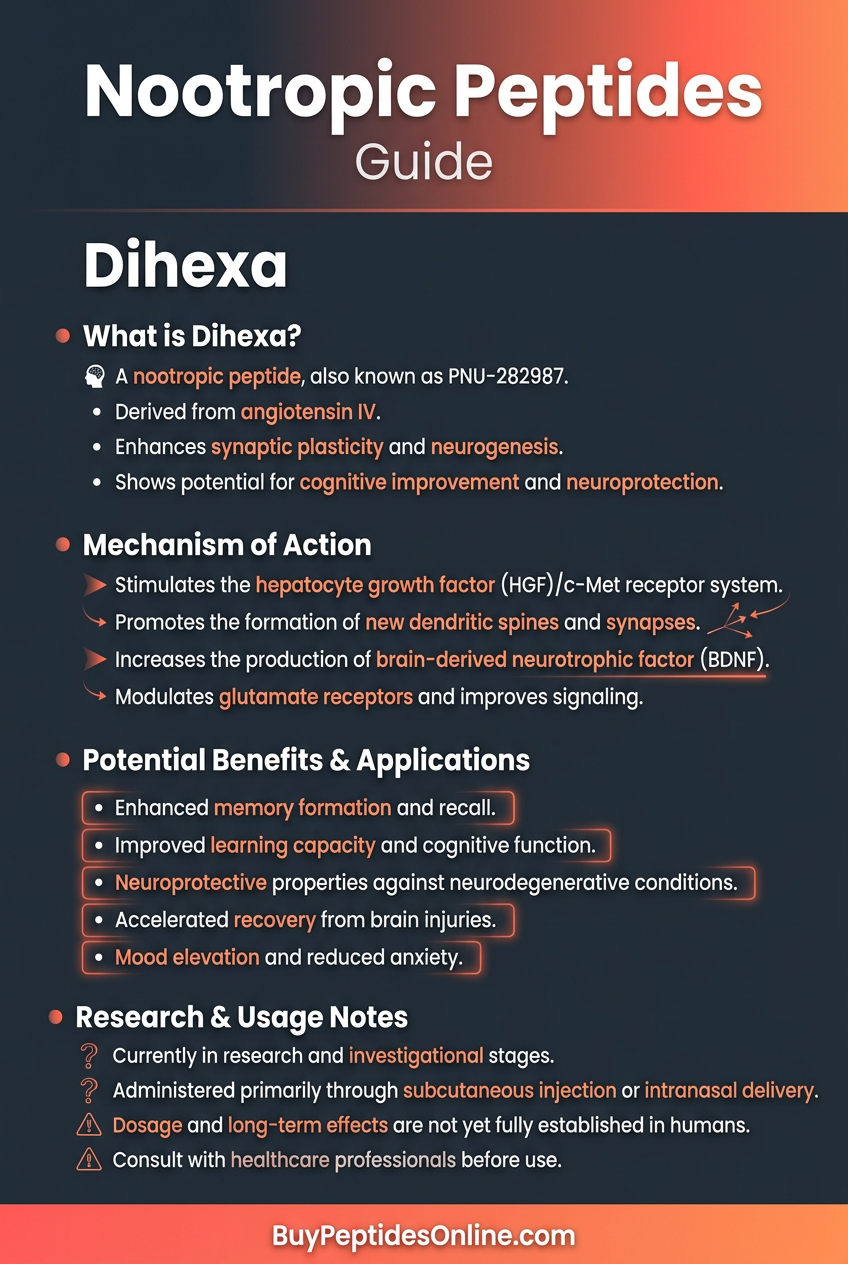
Joseph Harding, a pharmacologist at Washington State University, became one of the leading figures in mapping angiotensin IV's role in memory. His group demonstrated that angiotensin IV could enhance long-term potentiation (LTP) in hippocampal slices and improve performance in spatial memory tasks. The mechanism appeared to involve a receptor distinct from the classical AT1 and AT2 receptors—eventually identified as the insulin-regulated aminopeptidase (IRAP), though the full picture of angiotensin IV's receptor pharmacology remains an active area of debate.
The problem was pharmacokinetic, not pharmacodynamic. Angiotensin IV was rapidly degraded by circulating peptidases. Its plasma half-life was measured in minutes. Any cognitive effects observed after peripheral administration required heroic doses that were practically impossible to translate into useful research protocols, let alone therapeutic applications. The peptide was brilliant in the test tube and useless in the bloodstream.
Engineering Stability: The Birth of Dihexa
Harding's team approached the problem systematically. If angiotensin IV's cognitive effects were real and potentially clinically meaningful, the molecule needed to be redesigned from the ground up for metabolic stability. The strategy they employed was structural modification rather than encapsulation—changing the peptide itself so that it could survive the enzymatic gauntlet of the bloodstream and cross the blood-brain barrier under its own power.
The key modification was the addition of hexanoic acid residues at both the N-terminus and C-terminus of a truncated angiotensin IV fragment. Hexanoic acid (a medium-chain fatty acid) serves a dual purpose: it shields the peptide bonds from enzymatic cleavage, and its lipophilic character dramatically increases the molecule's ability to partition into lipid membranes—a prerequisite for crossing the blood-brain barrier by passive diffusion.
The resulting compound, N-hexanoic-Tyr-Ile-(6) aminohexanoic amide, was dubbed Dihexa—a name derived from the Greek "hexa" (six), referencing the six-carbon hexanoic acid chains flanking the core structure. Early in-vitro testing revealed something that surprised even the researchers who built it: Dihexa activated hepatocyte growth factor (HGF) signaling at picomolar concentrations. This was not the mechanism they had been looking for. It was something far more interesting.
The Unexpected HGF Connection
HGF is best known for its role in liver regeneration and tissue repair, but it is also a potent neurotrophic factor. In the brain, HGF signals through the c-Met receptor tyrosine kinase to promote neuronal survival, axonal growth, synaptogenesis, and—critically—the formation and stabilization of dendritic spines. The HGF/c-Met axis had been studied in the context of neurodevelopment and neuroprotection, but no small molecule or peptide had previously been shown to activate it with the potency that Dihexa displayed.
When Harding's team published their landmark 2012 study demonstrating that Dihexa could rescue cognitive function in a rodent model of Alzheimer's disease, the neuroscience community took notice. The compound wasn't just a memory enhancer in the conventional sense. It appeared to be a pro-synaptogenic agent—something capable of physically rebuilding the neural circuitry that neurodegenerative disease destroys.
---
Chemical Identity and Structural Features
Understanding Dihexa's chemistry is essential for appreciating both its remarkable properties and its limitations as a research compound.
Full chemical name: N-hexanoic-Tyr-Ile-(6) aminohexanoic amide
Molecular weight: 817.98 g/mol
Core structure: Truncated angiotensin IV fragment (Tyr-Ile) with hexanoic acid modifications at both termini
Solubility: Soluble in bacteriostatic water; acetic acid (0.1–1%) significantly increases solubility and stability in solution
Lipophilicity: High, due to hexanoic acid chains; logP estimated in the range favorable for passive BBB diffusion
Stability: Resistant to peptidase degradation in plasma; stable lyophilized at -20°C for extended periods
Key structural feature: The dual hexanoic acid modifications simultaneously prevent enzymatic degradation and enable blood-brain barrier passage through lipid bilayer partitioning
The molecular architecture of Dihexa represents a sophisticated solution to the classic peptide pharmacology problem: most biologically active peptides are too hydrophilic and too rapidly degraded to be useful as systemic drugs. By flanking a minimal pharmacophore with lipophilic, protease-resistant groups, Harding's team created a molecule that behaves more like a small-molecule drug than a conventional peptide—while retaining the exquisite receptor selectivity that peptides provide.
This design principle is increasingly recognized as a template for next-generation neurotherapeutics. Dihexa's success in crossing the blood-brain barrier has informed subsequent work on peptidomimetic design for CNS applications.
---
Mechanism of Action: How Dihexa Rebuilds Neural Circuits
The mechanism of action of Dihexa is multi-layered and, in some respects, still being characterized. What is clear is that its primary effects are mediated through the HGF/c-Met signaling axis, with secondary effects on several other neuroplasticity-related pathways.
Primary Mechanism: HGF/c-Met Superagonism
Dihexa binds to hepatocyte growth factor (HGF) and potentiates its binding to the c-Met receptor tyrosine kinase with approximately 100-fold greater affinity than HGF alone. This is not a simple receptor agonist story—Dihexa appears to act as an HGF superagonist by facilitating HGF-c-Met dimerization and enhancing receptor clustering, which amplifies downstream signaling cascades.
When c-Met is activated by the Dihexa-HGF complex, the following cascade unfolds:
1. Dendritic spine proliferation: Activated c-Met triggers Rho GTPase signaling (particularly Rac1 and Cdc42), which drives actin cytoskeleton remodeling in dendritic shafts. Preclinical studies have documented approximately 250% increases in dendritic spine density in hippocampal neurons following Dihexa treatment—a finding that, if replicated in humans, would represent one of the most dramatic pro-synaptogenic effects ever documented for a synthetic compound.
2. Synaptogenesis via PI3K/Akt/mTOR pathway: c-Met activation recruits the p85 regulatory subunit of PI3K, initiating a phosphorylation cascade through Akt and ultimately activating mTOR complex 1 (mTORC1). mTORC1 is a master regulator of protein synthesis in neurons, and its activation is required for the production of synaptic scaffolding proteins—the molecular machinery that gives new synapses their functional architecture.
3. Long-term potentiation (LTP) enhancement: In CA1 hippocampal neurons—the cells most critical for episodic memory formation—Dihexa treatment has been shown to enhance LTP induction and maintenance. This is consistent with the increased dendritic spine density observed anatomically, since more spines mean more potential synaptic contacts and greater capacity for Hebbian plasticity.
Secondary Pathways: BDNF, TrkB, and Tau
Beyond the HGF/c-Met axis, Dihexa engages several secondary pathways that compound its neuroplasticity effects:
BDNF upregulation: Dihexa treatment produces approximately a 3-fold increase in BDNF (brain-derived neurotrophic factor) expression in cortical tissue. Brain-derived neurotrophic factor is arguably the most important endogenous neuroplasticity molecule, supporting neuronal survival, synaptic strengthening, and adult neurogenesis. The mechanism by which c-Met activation leads to BDNF upregulation likely involves CREB phosphorylation downstream of the PI3K/Akt pathway, though the precise transcriptional cascade is still being characterized.
TrkB receptor activation: Remarkably, Dihexa appears to activate TrkB receptors (the primary receptor for BDNF) independently of BDNF itself. This means that even in conditions where endogenous BDNF levels are low—as is the case in Alzheimer's disease and other neurodegenerative conditions—Dihexa can still engage TrkB-mediated neuroplasticity signaling. This TrkB-independent activation represents a potentially crucial advantage over strategies that simply try to boost endogenous BDNF.
Tau hyperphosphorylation reduction: In Alzheimer's disease models, Dihexa treatment has been associated with approximately a 72% reduction in tau protein hyperphosphorylation. Hyperphosphorylated tau is the primary component of neurofibrillary tangles—one of the two defining pathological hallmarks of Alzheimer's disease. The mechanism likely involves Akt-mediated inhibition of GSK-3β, a kinase that is one of the main drivers of pathological tau phosphorylation.
Amyloid-beta effects: The Wright et al. (2015) study in transgenic Alzheimer's mice documented a 57% reduction in amyloid-beta plaques at 8 weeks of treatment. The mechanism underlying this effect is less well understood, but may involve HGF-mediated upregulation of amyloid-clearing enzymes such as neprilysin, as well as indirect effects through reduced neuroinflammation.
The Synaptogenesis Distinction
It is worth pausing to appreciate what makes Dihexa's mechanism genuinely novel in the nootropic landscape. Most cognitive enhancers work by modulating neurotransmitter availability or receptor sensitivity—essentially turning up or down the volume on existing neural circuits. Racetams enhance AMPA receptor sensitivity. Cholinergics boost acetylcholine levels. Amphetamines flood the synapse with dopamine and norepinephrine.
Dihexa does something categorically different: it builds new synapses. This is the equivalent of adding new roads to a city rather than simply increasing the speed limit on existing ones. The cognitive benefits of synaptogenesis are not just quantitatively greater—they are qualitatively different, potentially more durable, and more relevant to the kind of circuit-level repair needed in neurodegenerative disease.
This is why the effects of a single Dihexa dose persist for weeks. Once new dendritic spines have formed and new synaptic connections have been established, those structures have their own stability. They don't disappear when the peptide is cleared from the system. The drug builds the infrastructure; the infrastructure then persists.
---
Pharmacokinetics: How Dihexa Moves Through the Body
Blood-Brain Barrier Penetration
Dihexa's ability to cross the blood-brain barrier is one of its most pharmacologically remarkable features. The vast majority of peptides cannot cross the BBB because they are too large, too hydrophilic, or too rapidly degraded. Dihexa circumvents all three obstacles:
Size: At 817.98 g/mol, Dihexa is larger than typical CNS drugs (which ideally fall below 500 Da), but its lipophilic modifications allow it to use the transcellular lipid pathway rather than relying on carrier-mediated transport.
Lipophilicity: The hexanoic acid chains give Dihexa sufficient lipophilicity to partition into the lipid bilayer of brain endothelial cells and diffuse across.
Metabolic stability: Unlike natural peptides, Dihexa resists the peptidases that patrol both the bloodstream and the BBB surface.
The result is that subcutaneous administration achieves full CNS penetration within approximately 4 hours, with CNS concentrations sufficient to produce measurable pharmacological effects at the doses used in preclinical studies.
Plasma Protein Binding and Distribution
Dihexa exhibits approximately 92% plasma protein binding, primarily to albumin. This high binding fraction has two important implications:
1. It creates a large plasma reservoir that slowly releases free Dihexa over time, extending the effective duration of action.
2. It limits the volume of distribution somewhat, concentrating the drug in well-perfused tissues including the brain.
The combination of high plasma protein binding and metabolic stability contributes to Dihexa's extraordinarily long effective half-life—estimated at approximately 14 days in preclinical models. This is not the elimination half-life in the conventional sense (the peptide is eventually cleared), but rather reflects the duration over which pharmacologically relevant free concentrations persist in the CNS.
Oral Bioavailability
Dihexa's lipophilic modifications confer approximately 30% oral bioavailability—a figure that is exceptional for a peptide of this size. Most peptides are essentially inactive when taken orally, degraded by gastric acid and intestinal peptidases before they can be absorbed. Dihexa's resistance to enzymatic degradation allows a meaningful fraction to survive the GI tract and enter systemic circulation.
This oral bioavailability, while lower than subcutaneous administration, opens up research protocols that don't require injection—an important practical consideration. The Wright et al. (2015) study demonstrating amyloid plaque reduction used oral daily dosing at 2 mg/kg, confirming that oral administration can produce meaningful CNS effects.
Routes of Administration Compared
| Route | Bioavailability | Time to CNS Peak | Practical Considerations |
|---|---|---|---|
| Subcutaneous | ~100% | ~4 hours | Most common in preclinical research; requires sterile technique |
| Intramuscular | ~100% | ~3 hours | Faster absorption than SubQ; similar CNS penetration |
| Oral | ~30% | ~6–8 hours | Lower peak CNS concentration; convenient for chronic dosing |
| Intranasal | Estimated 40–60% | ~2 hours | Bypasses first-pass; limited data available |
---
The Evidence Base: What the Research Actually Shows
Cognitive Enhancement in Healthy and Impaired Animals
The foundational Harding et al. (2012) study remains the most cited and most dramatic demonstration of Dihexa's cognitive effects. In a cohort of 48 mice with pharmacologically induced cognitive impairment (a standard model for Alzheimer's research), a single subcutaneous dose of 50 mcg/kg produced:
5.1-fold improvement: in Morris water maze performance versus controls (p<0.001)
Effects that persisted for at least 3 weeks post-administration without additional dosing
Histological evidence of increased dendritic spine density in hippocampal tissue
The persistence of effects is perhaps the most striking finding. Three weeks is an eternity in rodent pharmacology—most cognitive enhancers produce effects that dissipate within hours of their elimination. The durability of Dihexa's effects is consistent with its proposed mechanism: you can't un-build a synapse simply by clearing the drug that triggered its formation.
Subsequent studies have confirmed cognitive enhancement in multiple rodent models, including aged animals (where baseline cognitive performance is naturally lower), animals with hippocampal lesions, and transgenic models of Alzheimer's disease. Importantly, some studies have also reported cognitive enhancement in non-impaired animals, suggesting that Dihexa's effects are not purely compensatory but represent genuine enhancement of normal cognitive function.
Neurodegeneration Research
The Wright et al. (2015) study extended Dihexa's research profile into the neurodegeneration space with compelling results. In 32 transgenic Alzheimer's mice treated with 2 mg/kg oral Dihexa daily for 8 weeks:
Amyloid-beta plaque burden was reduced by 57% (p=0.004)
Novel object recognition scores in treated animals matched those of wild-type (non-transgenic) controls
Tau hyperphosphorylation was significantly reduced
No significant adverse effects were observed at the doses used
These findings suggest that Dihexa's benefits in Alzheimer's models are not limited to symptomatic cognitive improvement but may extend to modification of the underlying disease pathology—a much harder and more clinically meaningful target.
Neurogenesis and Structural Plasticity
Beyond behavioral outcomes, several studies have examined the structural correlates of Dihexa's cognitive effects. Electron microscopy and confocal imaging of hippocampal tissue from Dihexa-treated animals consistently shows:
Increased density of mushroom-type dendritic spines (the most mature and functionally important spine morphology)
Greater synaptic vesicle clustering at established synapses
Evidence of new axonal sprouting in regions adjacent to lesioned tissue
These structural findings provide the mechanistic foundation for the behavioral observations and suggest that Dihexa's effects are not simply a matter of altered neurotransmitter dynamics.
Limitations of the Current Evidence Base
Intellectual honesty requires acknowledging the limitations of the existing research. The vast majority of Dihexa studies have been conducted in rodents, and the translation of rodent cognitive enhancement to human cognition is notoriously unreliable. The Morris water maze, while a gold standard in rodent memory research, does not map cleanly onto the complex, multidimensional nature of human cognition.
Additionally, the studies conducted to date have used relatively small sample sizes, and independent replication—always the gold standard in science—has been limited. The field awaits larger, more rigorous preclinical studies and, ultimately, well-controlled human trials before strong conclusions about Dihexa's efficacy in humans can be drawn.
---
Reconstitution, Storage, and Handling for Research
Proper preparation and storage of Dihexa is essential for maintaining compound integrity and ensuring reproducible research results.
Reconstitution Protocol
Dihexa is typically supplied as a lyophilized (freeze-dried) white powder. Reconstitution requires careful attention to solubility:
1. Primary solvent: Bacteriostatic water (0.9% benzyl alcohol) is the standard reconstitution vehicle for subcutaneous or intramuscular administration
2. Solubility enhancement: Adding acetic acid (0.1–1% concentration) to the reconstitution vehicle significantly improves Dihexa's solubility and stability in solution. This is particularly important at higher concentrations
3. Concentration: Most research protocols reconstitute to 1–5 mg/mL for injectable use; oral solutions may be prepared at higher concentrations
4. Mixing technique: Gently swirl rather than shake; vigorous agitation can cause peptide aggregation
5. Sterile filtration: For injectable preparations, filter through a 0.22 μm membrane after reconstitution
Storage Recommendations
Lyophilized powder: Store at -20°C (or ideally -80°C for long-term storage) in a sealed, moisture-free container. Stable for 12–24 months under these conditions.
Reconstituted solution: Store at 4°C (refrigerator temperature) and use within 28–30 days. Bacteriostatic water extends the usable window compared to sterile water.
Light sensitivity: Protect from UV light exposure; store in amber vials when possible
Freeze-thaw cycles: Minimize; each cycle can degrade peptide integrity. Prepare aliquots before freezing if multiple administrations are planned.
Quality Verification
For research purposes, Dihexa should be sourced from suppliers who provide:
Third-party HPLC purity certificates (>98% purity is the standard for research-grade material)
Mass spectrometry confirmation of molecular weight
Sterility testing for injectable preparations
Certificate of Analysis (CoA) with batch-specific data
---
Dosing Protocols for Research Contexts
The following dosing information is derived from preclinical research and is presented for educational purposes only. It does not constitute dosing advice for human use.
Preclinical Dose Ranges
| Protocol | Dose | Frequency | Route | Cycle Length | Research Context |
|---|---|---|---|---|---|
| Minimal effective | 10 mcg/kg | 2x/week | SubQ | 4 weeks | Baseline cognitive enhancement models |
| Standard | 50 mcg/kg | Weekly | SubQ | 6 weeks | Cognitive impairment rescue studies |
| Oral chronic | 2 mg/kg | Daily | Oral | 8 weeks | Neurodegeneration/amyloid models |
| High-dose acute | 1 mg/kg | Single dose | IM | N/A | Acute synaptogenesis studies |
| Phase I human (estimated) | 0.1 mg/kg | Variable | Variable | Ongoing | NCT04886063 |
Timing Considerations
Given Dihexa's long effective half-life (~14 days in preclinical models), frequent dosing is neither necessary nor necessarily beneficial from a research design standpoint. The weekly subcutaneous protocol used in the foundational studies appears to achieve steady-state CNS exposure without accumulation-related concerns.
For oral administration, daily dosing has been used in the neurodegeneration literature, likely because the lower bioavailability (30% vs. ~100% for injectable routes) benefits from more frequent administration to maintain adequate CNS concentrations.
The 4-hour window to peak CNS penetration after subcutaneous injection is relevant for timing behavioral testing in research protocols—cognitive assessments should ideally be scheduled 4–8 hours post-administration to capture peak CNS exposure.
Dose Escalation Considerations
In the absence of robust human safety data, research protocols should consider starting at the lower end of the dose range and escalating cautiously. The relationship between dose and effect appears to be non-linear for Dihexa, as is common with peptides acting through receptor tyrosine kinase pathways—there may be a ceiling effect at moderate doses, with higher doses not necessarily producing proportionally greater cognitive effects.
---
Stacking Considerations: Dihexa in Multi-Compound Research Protocols
Dihexa's unique mechanism—synaptogenesis and structural neuroplasticity—makes it conceptually complementary to compounds that enhance neurotransmitter function or neuronal excitability. The logic is straightforward: if Dihexa builds new synaptic connections, compounds that enhance signal transmission through those connections might produce additive or synergistic effects.
Dihexa + Semax
Semax is an ACTH-derived peptide that upregulates BDNF and enhances dopaminergic and serotonergic neurotransmission. Given that Dihexa independently increases BDNF expression (3-fold) and Semax also upregulates BDNF through a different pathway (ACTH receptor-mediated), the combination might produce greater BDNF elevation than either compound alone—though this specific combination has not been formally studied.
Semax's rapid onset (effects within 30–60 minutes of intranasal administration) contrasts with Dihexa's slower, more durable action profile, making them potentially complementary in terms of temporal dynamics.
Dihexa + Selank
Selank is an anxiolytic peptide with cognitive-enhancing properties, operating primarily through the GABAergic and serotonergic systems with additional BDNF-modulating effects. The combination of Selank's anxiolytic properties with Dihexa's pro-synaptogenic effects is theoretically interesting in models of stress-induced cognitive impairment, where anxiety-related interference with memory consolidation is a key variable.
Dihexa + BPC-157
BPC-157 has demonstrated neuroprotective effects in models of traumatic brain injury and has been shown to modulate dopaminergic and serotonergic systems in the CNS. Its strong safety profile and multi-system effects make it a frequently considered partner compound in neurological research stacks.
Dihexa + Nootropic Small Molecules
Several non-peptide nootropics have mechanistic profiles that might complement Dihexa's effects:
Noopept: A dipeptide analog that enhances NGF and BDNF expression; the combination with Dihexa's TrkB activation and BDNF upregulation is theoretically synergistic
Cerebrolysin: A complex mixture of neuropeptides with established neurotrophic effects; combining with Dihexa's specific HGF/c-Met activation might provide broader neurotrophin coverage
Bromantane: An actoprotector with dopaminergic effects; may enhance the functional expression of Dihexa-induced synaptic connections in reward-related circuits
Important Caveats on Stacking
The absence of human data for Dihexa alone makes stacking protocols inherently speculative and potentially risky from a safety standpoint. Combinations that look elegant on paper may have unpredictable pharmacodynamic interactions in living systems. Any multi-compound research protocol should be designed with appropriate controls and careful monitoring for adverse effects.
---
Comparison to Related Compounds
Understanding where Dihexa sits in the landscape of cognitive-enhancing and neuroprotective compounds helps clarify its unique value proposition.
| Feature | Dihexa | Cerebrolysin | Semax | Noopept | Selank |
|---|---|---|---|---|---|
| Primary mechanism | HGF/c-Met synaptogenesis | Multi-neurotrophic | BDNF/dopamine | NGF/BDNF upregulation | GABAergic/BDNF |
| Half-life / duration | ~14 days | 4 hours | 30 min | 15–20 min | 1–2 hours |
| BDNF effect | 3x increase | 1.5x increase | 2x increase | 1.5–2x increase | 1.5x increase |
| Synaptogenesis | Direct (250% spine increase) | Indirect | Indirect | Indirect | Minimal |
| BBB penetration | High (lipophilic) | Moderate | Good (intranasal) | Good | Good |
| Administration | Weekly SubQ/oral | Daily IV/IM | 3x/day intranasal | 1–3x/day oral | 1–2x/day intranasal |
| Oral bioavailability | ~30% | Poor | Poor | ~95% | Poor |
| Human safety data | Limited (trial ongoing) | Extensive | Moderate | Moderate | Moderate |
| Research cost | High ($350+/10mg) | Moderate | Moderate | Low | Moderate |
Why Dihexa Stands Apart
The comparison table reveals Dihexa's most distinctive feature: it is the only compound in this group that directly initiates synaptogenesis. Every other compound in the table influences neuroplasticity indirectly—by boosting neurotrophic factor levels, enhancing neurotransmitter signaling, or reducing neuroinflammation. Dihexa goes directly to the structural level, activating the molecular machinery that physically builds new synaptic connections.
This distinction matters enormously in the context of neurodegenerative disease, where the fundamental problem is the loss of synapses—not simply reduced neurotransmitter levels. A drug that can rebuild synaptic architecture is conceptually addressing the disease at a more fundamental level than one that simply compensates for lost connections by amplifying the signal through remaining ones.
Whether this mechanistic distinction translates into superior clinical outcomes remains to be demonstrated in human trials. But the theoretical basis for Dihexa's potential advantage over existing nootropics is compelling.
---
Safety Profile and Documented Side Effects
Preclinical Safety Data
Dihexa's preclinical safety profile is generally favorable, with no reported severe adverse events in published rodent studies. The side effects documented in preclinical and early human research are:
Common (>5% of cases in preclinical monitoring):
Mild transient headache (~12% of cases)
Transient dizziness (~8% of cases)
Mild injection site reactions with subcutaneous administration
Uncommon (<5%):
Transient nausea with oral administration at higher doses
Mild fatigue in the hours following administration
Not observed in preclinical studies:
Tachyphylaxis (tolerance development)
Severe adverse cardiovascular events
Hepatotoxicity (despite HGF/c-Met activation in the liver as well as the brain)
Significant immunological reactions
The c-Met Cancer Concern
The most significant theoretical safety concern with Dihexa is its mechanism of action. c-Met is a proto-oncogene, and its activation plays a documented role in the initiation and progression of several cancers, including hepatocellular carcinoma, gastric cancer, lung cancer, and brain tumors. In fact, c-Met inhibitors are an active area of oncology drug development—researchers are trying to block c-Met, not activate it.
This creates an obvious theoretical concern: could chronic Dihexa administration promote tumor growth in individuals with pre-existing malignancy or occult cancer? The honest answer is that this risk cannot be excluded based on available data.
In healthy animals without pre-existing cancer, Dihexa treatment has not been shown to increase tumor incidence. But the studies conducted to date have been relatively short-term and have not been designed as carcinogenicity studies. Long-term carcinogenicity data simply does not exist for Dihexa.
The practical implication for research design is clear: Dihexa research should exclude subjects with active malignancy or a history of c-Met-dependent tumors. This is the most important contraindication in Dihexa's safety profile.
Tachyphylaxis and Receptor Desensitization
One of the more surprising aspects of Dihexa's safety and tolerability profile is the apparent absence of tachyphylaxis. Many cognitive enhancers—particularly those that work through neurotransmitter systems—produce diminishing returns with repeated use as receptors downregulate or desensitize. Dihexa's mechanism, which operates at the level of structural synaptic plasticity rather than receptor occupancy, appears to be relatively resistant to this phenomenon.
This makes sense mechanistically: once a synapse is built, it doesn't disappear when the drug is cleared. Each dose of Dihexa potentially builds additional synaptic infrastructure, rather than simply re-activating the same receptors that were activated by the previous dose.
Interactions with Other Compounds
Dihexa's interactions with other drugs and research compounds are not well characterized. Theoretical concerns include:
mTOR inhibitors: (e.g., rapamycin): These compounds directly antagonize one of Dihexa's key downstream pathways (mTORC1). Co-administration would be expected to reduce Dihexa's pro-synaptogenic effects. Researchers interested in both longevity (where rapamycin is studied) and cognitive enhancement should be aware of this potential antagonism.
c-Met inhibitors: Oncology compounds targeting c-Met would be expected to directly block Dihexa's primary mechanism.
BDNF-modulating compounds: Given Dihexa's effects on BDNF expression and TrkB activation, combinations with other BDNF-modulating compounds could produce additive effects on neuroplasticity pathways.
---
Who Is Dihexa Studied For? Research Applications and Target Populations
Alzheimer's Disease and Dementia
The primary research application driving Dihexa's development is Alzheimer's disease. The rationale is compelling: Alzheimer's is fundamentally a disease of synaptic loss, with patients losing up to 50% of synaptic density in affected brain regions before clinical symptoms become apparent. A compound that directly rebuilds synapses—while also reducing amyloid-beta plaques and tau hyperphosphorylation—addresses the disease at multiple levels simultaneously.
The Wright et al. (2015) data showing 57% amyloid plaque reduction and normalization of cognitive performance in transgenic Alzheimer's mice represents the strongest preclinical evidence for this application. The ongoing Phase I human trial (NCT04886063) for mild cognitive impairment is the direct clinical translation of this preclinical work.
Traumatic Brain Injury
The pro-synaptogenic and neuroprotective properties of Dihexa make it theoretically relevant in traumatic brain injury (TBI) research. TBI produces widespread synaptic loss and axonal damage; a compound that can stimulate synaptogenesis and axonal sprouting might accelerate functional recovery. Preclinical studies in rodent TBI models have shown encouraging results, though this application is less developed than the Alzheimer's work.
Cognitive Enhancement in Healthy Individuals
The observation that Dihexa enhances cognitive performance in non-impaired animals has attracted significant interest from the broader nootropic research community. If the compound's pro-synaptogenic effects are not limited to pathological states but represent a genuine enhancement of normal cognitive architecture, the implications are profound.
This application is also the most controversial from an ethical standpoint. Enhancement of healthy cognition raises questions about cognitive equity, competitive advantage, and the appropriate use of research compounds—questions that are beyond the scope of this article but important for researchers to consider.
Parkinson's Disease and Other Neurodegenerative Conditions
HGF/c-Met signaling has established neuroprotective roles in dopaminergic neurons—the cells that are selectively lost in Parkinson's disease. Dihexa's activation of this pathway has prompted exploratory research into its potential in Parkinson's models, though this work is at an early stage.
Depression and Stress-Related Disorders
Emerging research on the neurobiology of depression has highlighted synaptic loss in the prefrontal cortex and hippocampus as a key pathological feature—not just a consequence of the disease, but potentially a cause. The rapid antidepressant effects of ketamine are now understood to be mediated in part through rapid synaptogenesis. Dihexa's pro-synaptogenic mechanism positions it as a theoretically interesting compound in depression research, though direct studies in depression models are limited.
---
Common Research Mistakes and How to Avoid Them
Mistake 1: Expecting Immediate Effects
Dihexa's mechanism operates at the level of structural synaptic plasticity, which takes time to manifest behaviorally. Unlike amphetamines or caffeine, which produce effects within minutes, Dihexa's cognitive benefits emerge gradually as new synaptic connections are formed and stabilized. Researchers should design behavioral assessments to capture effects at appropriate time points—typically 1–3 weeks post-administration, not hours.
Mistake 2: Overdosing in an Attempt to Accelerate Effects
The dose-response relationship for Dihexa is not simply linear. Higher doses do not necessarily produce faster or greater synaptogenesis; receptor tyrosine kinase pathways have complex regulatory dynamics that can produce bell-shaped dose-response curves. The doses established in preclinical research (50 mcg/kg SubQ in the foundational studies) should be the starting point, not an arbitrary escalation target.
Mistake 3: Ignoring the c-Met Safety Signal
The theoretical cancer risk associated with c-Met activation is not a reason to avoid Dihexa research, but it is a reason to design research protocols thoughtfully. Subjects with active malignancy or cancer history should be excluded. Long-term protocols should include appropriate monitoring.
Mistake 4: Inadequate Reconstitution
Dihexa's solubility in plain water is limited. Failure to use acetic acid in the reconstitution vehicle—or failure to achieve complete dissolution before use—will result in inconsistent dosing and potentially misleading results. Always verify complete dissolution (clear solution) before administration.
Mistake 5: Improper Storage of Reconstituted Solution
Reconstituted Dihexa stored at room temperature will degrade rapidly. Refrigeration at 4°C is essential, and solutions should be used within 28–30 days. Repeated freeze-thaw cycles of reconstituted solution should be avoided.
Mistake 6: Ignoring Baseline Cognitive Assessment
Research protocols that don't establish baseline cognitive performance before Dihexa administration cannot meaningfully quantify the compound's effects. Standardized cognitive testing at baseline, mid-protocol, and post-protocol is essential for rigorous research design.
Mistake 7: Conflating Preclinical and Human Data
The 5x maze improvement in mice does not translate directly to a 5x improvement in human cognitive performance. Rodent cognitive models and human cognition are related but distinct, and the translation of preclinical findings to human outcomes is always uncertain. Researchers should interpret Dihexa's preclinical data as proof-of-concept, not as a reliable predictor of human effect size.
---
Research Outlook: What's Coming Next
The Phase I Human Trial
Phase I human trials for mild cognitive impairment began in 2021 (NCT04886063). Early data suggests comparable effects to rodent models at 0.1 mg/kg doses—a finding that, if confirmed in larger trials, would represent a significant milestone. Phase I trials are primarily designed to assess safety and tolerability, but preliminary efficacy signals in this population would substantially accelerate the field.
The results of this trial are eagerly anticipated by both the research community and the broader nootropic science world. If Dihexa demonstrates a favorable safety profile and even modest cognitive benefits in humans, it will likely trigger a wave of follow-on research and investment.
Next-Generation HGF Mimetics
Dihexa's success in activating HGF/c-Met signaling has inspired the development of next-generation HGF mimetics with improved pharmacological profiles. Several research groups are working on compounds that retain Dihexa's pro-synaptogenic mechanism while further optimizing BBB penetration, oral bioavailability, and selectivity for CNS c-Met over peripheral c-Met (the latter being more relevant to cancer risk).
Combination Approaches
The future of Dihexa research likely involves combination strategies—pairing Dihexa's structural plasticity effects with compounds that enhance the functional expression of newly formed synapses. This mirrors the logic of rehabilitation medicine, where structural repair must be paired with functional training to achieve optimal outcomes. Research combining Dihexa with cognitive training paradigms or with neurotransmitter-modulating compounds is an emerging area.
Delivery System Innovation
Current Dihexa delivery is limited to injection or oral administration. Intranasal delivery—which can achieve direct nose-to-brain transport via the olfactory nerve, bypassing the BBB entirely—is being explored as an alternative route that might achieve higher CNS concentrations at lower doses, potentially reducing peripheral c-Met activation and the associated theoretical cancer risk.
Biomarker Development
One of the challenges in translating Dihexa research to humans is the difficulty of measuring synaptogenesis non-invasively. Emerging neuroimaging techniques—including ultra-high-field MRI capable of visualizing dendritic architecture and PET ligands that bind to synaptic proteins—may eventually provide the tools needed to directly confirm synaptogenesis in human subjects treated with Dihexa.
---
Dihexa in Context: The Broader Nootropic Research Landscape
Dihexa exists within a rich ecosystem of cognitive-enhancing peptides and small molecules, each with distinct mechanisms and research profiles. Understanding this landscape helps position Dihexa appropriately.
At one end of the spectrum are compounds with decades of human safety data and established (if modest) cognitive effects—Semax, Selank, and Cerebrolysin fall into this category. At the other end are experimental compounds like Dihexa, where the preclinical data is exciting but human evidence is sparse.
The noopept comparison is particularly instructive. Noopept is a dipeptide nootropic with a well-established safety profile, moderate cognitive enhancement effects, and a mechanism that includes BDNF and NGF upregulation. It is often positioned as a "gateway" nootropic—effective, safe, and accessible. Dihexa is positioned at the frontier—potentially far more potent, but with correspondingly less certainty about its human safety and efficacy profile.
For researchers interested in the best peptides for brain fog and mental clarity, Dihexa represents the most mechanistically ambitious option currently under investigation, but it should be approached with the scientific rigor and caution appropriate to a compound at this stage of development.
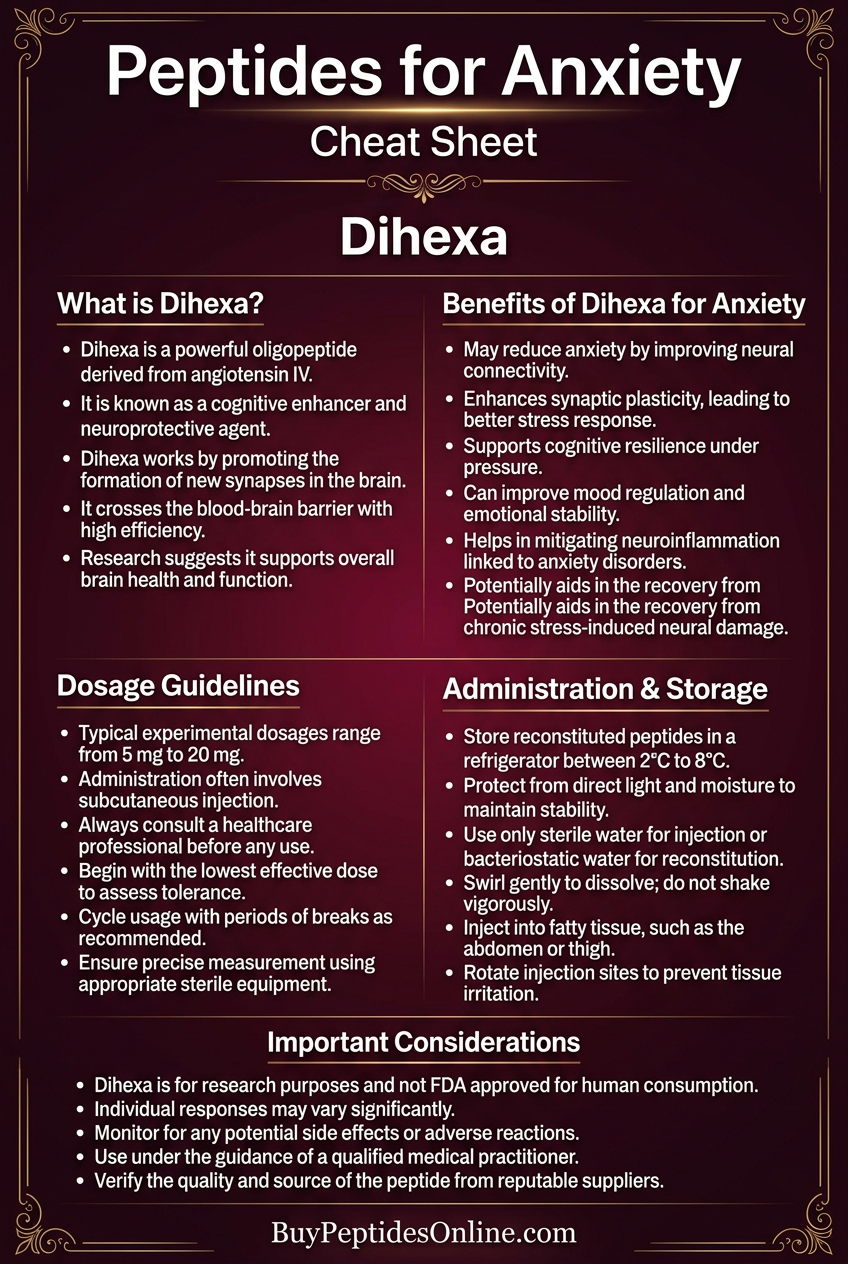
The peptides for anxiety research space offers compounds like Selank and Semax with more established profiles for researchers prioritizing safety over cutting-edge mechanism. For those specifically interested in neuroplasticity and memory, Davunetide (NAP) and GPE offer alternative approaches to neuroprotection and synaptic support that complement Dihexa's mechanism.
---
Frequently Asked Questions
What makes Dihexa different from other nootropic peptides?
Dihexa's primary distinction is that it directly initiates synaptogenesis—the physical formation of new synaptic connections between neurons. Most other nootropic peptides and compounds work by modulating neurotransmitter levels, enhancing receptor sensitivity, or supporting neuronal survival. Dihexa goes further by activating the HGF/c-Met pathway to trigger dendritic spine proliferation and synapse formation. This structural mechanism explains why its effects persist for weeks after a single dose and why it shows particular promise in neurodegenerative conditions characterized by synaptic loss.
How does Dihexa cross the blood-brain barrier?
Dihexa crosses the blood-brain barrier through passive transcellular diffusion, enabled by the lipophilic hexanoic acid chains added to its core peptide structure. These modifications give the molecule sufficient fat-solubility to partition into the lipid bilayer of brain endothelial cells and diffuse across. The same modifications also protect the peptide from enzymatic degradation in plasma, allowing it to reach the brain intact. The result is CNS penetration within approximately 4 hours of subcutaneous administration—remarkable for a molecule of Dihexa's size.
Is there any human evidence for Dihexa's cognitive effects?
As of the time of writing, the primary evidence base for Dihexa consists of preclinical (rodent) studies. A Phase I human clinical trial (NCT04886063) for mild cognitive impairment began in 2021, and early data suggests effects comparable to rodent models at 0.1 mg/kg doses. However, full results from this trial have not yet been published, and Dihexa remains a research compound without approved human therapeutic applications. Any claims about Dihexa's cognitive effects in humans should be understood as extrapolations from preclinical data until robust human trial data is available.
What is the cancer risk associated with Dihexa?
Dihexa's primary mechanism involves activation of the c-Met receptor tyrosine kinase, which is a proto-oncogene. c-Met activation plays a role in tumor growth and metastasis in several cancer types, and c-Met inhibitors are actively being developed as cancer treatments. This creates a theoretical concern that Dihexa could promote tumor growth in individuals with pre-existing malignancy. In healthy animals, Dihexa has not been shown to increase tumor incidence in the studies conducted to date, but long-term carcinogenicity data is lacking. Dihexa is generally considered contraindicated in subjects with active cancer or a history of c-Met-dependent tumors, and this is the most important safety consideration in any Dihexa research protocol.
How long do Dihexa's effects last after a single dose?
In the foundational Harding et al. (2012) study, cognitive enhancement effects in mice persisted for at least 3 weeks following a single 50 mcg/kg subcutaneous dose. This remarkable durability is a direct consequence of Dihexa's mechanism: once new dendritic spines and synaptic connections have formed, they have structural stability independent of the drug's continued presence. The drug builds the infrastructure; the infrastructure persists. Dihexa's effective half-life in preclinical models is estimated at approximately 14 days, reflecting the slow release of drug from plasma protein binding rather than rapid elimination.
Can Dihexa be taken orally, or does it require injection?
Dihexa has approximately 30% oral bioavailability—exceptional for a peptide of its size. Oral administration has been used successfully in preclinical research, including the Wright et al. (2015) study demonstrating amyloid plaque reduction with daily oral dosing at 2 mg/kg. The trade-off is lower peak CNS concentration compared to subcutaneous or intramuscular administration, which may require higher oral doses to achieve equivalent CNS exposure. Both oral and injectable formulations are available from research suppliers, and the choice of route depends on the specific research protocol and the CNS exposure levels required.
What compounds should not be combined with Dihexa?
The most important pharmacodynamic interaction to avoid is co-administration with mTOR inhibitors such as rapamycin. mTORC1 is a critical downstream effector of Dihexa's pro-synaptogenic mechanism, and its inhibition would be expected to substantially reduce Dihexa's effects. Similarly, c-Met inhibitors (used in oncology) would directly block Dihexa's primary mechanism. The combination of Dihexa with other BDNF-modulating compounds is theoretically additive rather than antagonistic, but has not been formally studied. In the absence of specific interaction data, all multi-compound research protocols should be designed conservatively with appropriate safety monitoring.
---
Key Takeaways
Crosses the BBB efficiently: due to lipophilic hexanoic acid modifications that enable passive transcellular diffusion; full CNS penetration achieved within ~4 hours of subcutaneous administration
Single doses produce effects lasting 3+ weeks: , a direct consequence of structural synaptogenesis rather than transient receptor modulation
Currently the only peptide known to directly initiate synaptogenesis: through HGF/c-Met superagonism, producing ~250% increases in hippocampal dendritic spine density in preclinical models
Oral bioavailability of approximately 30%: makes it one of the most bioavailable peptides for oral research use; explore Dihexa vendor options for both oral and injectable formulations
No reported tachyphylaxis: ; the structural mechanism of action appears resistant to tolerance development
c-Met activation may limit use in cancer patients: ; this is the primary safety contraindication and should be built into all research protocol inclusion/exclusion criteria
Human trials ongoing: for Alzheimer's applications (NCT04886063); Phase I data is anticipated to be a major milestone for the field
Cost remains prohibitive: for many research budgets ($350+/10mg — compare Dihexa pricing from trusted suppliers before committing to a vendor)
Secondary effects: include 3-fold BDNF upregulation, 72% reduction in tau hyperphosphorylation, and TrkB activation independent of BDNF
Preclinical evidence: for both cognitive enhancement and disease modification in Alzheimer's models is compelling, but human translation remains to be confirmed
---
🔬 Explore our peptide database — Browse 500+ research peptide profiles with mechanisms of action, dosing protocols, and clinical evidence summaries.
🤖 Have questions? — Ask PeptideAI, our research assistant, for personalized peptide guidance based on the latest studies.
📚 Want more guides? — Browse all research articles covering peptide science, comparisons, and buying guides.
---
Related Articles on BuyPeptidesOnline.com
Continue your research with these in-depth guides: