# Thymosin Beta-4 (TB-4): The Master Regulator of Tissue Repair and Regeneration
A cardiac surgeon stares at postoperative MRI scans showing something unprecedented. The patient's left ventricle—badly damaged by myocardial infarction—now displays new muscle tissue where only scar tissue should be. The culprit? An experimental protocol involving thymosin beta-4 (TB-4), a peptide originally found in blood platelets that's rewriting regenerative medicine's playbook.
This is not a story about a single molecule doing a single thing. TB-4 is arguably the most multidimensional repair peptide ever characterized—simultaneously governing cytoskeletal dynamics, inflammatory tone, angiogenesis, stem cell activation, and extracellular matrix remodeling. Understanding it fully requires diving deep into cell biology, pharmacokinetics, comparative peptide science, and an honest appraisal of what the research does—and does not—yet tell us.
*This article is intended for educational and research purposes only. Thymosin beta-4 is an investigational compound, not an approved drug or therapeutic. Nothing here constitutes medical advice. Researchers and clinicians should consult the primary literature and applicable regulatory frameworks before working with this compound.*
---
The Discovery: From Thymic Extract to Regenerative Powerhouse
The story of TB-4 begins not with a grand hypothesis about tissue repair, but with the painstaking biochemical work of immunologists trying to understand how the thymus gland orchestrates immune development. In 1966, Allan Goldstein and Abraham White at Yale first described a thymic extract—eventually called thymosin fraction 5—that could restore immune function in thymectomized animals. This crude mixture contained dozens of peptides, and the effort to identify individual active components would take another decade and a half.
By 1981, Dr. Allan Goldstein's team at George Washington University had isolated a specific 43-amino acid peptide from thymic tissue while studying immunomodulatory compounds. They named it thymosin beta-4, distinguishing it from the alpha-thymosins and from the larger thymosin fraction 5 mixture. Early work focused on its role in T-cell maturation and immune regulation—reasonable given its source tissue.
But the thymus turned out to be something of a red herring as far as TB-4's primary biology was concerned. As researchers developed more sensitive detection methods, they discovered that TB-4 is not thymus-specific at all. It is one of the most abundant intracellular peptides in virtually every mammalian cell type examined, with particularly high concentrations in platelets, white blood cells, and wound fluid. The thymus connection was an artifact of where it was first isolated, not a reflection of its primary functional domain.
The real paradigm shift came in the late 1990s and early 2000s when structural biologists solved the crystal structure of the TB-4:actin complex and revealed that the peptide's primary biochemical role was as a G-actin sequestering agent—a critical regulator of the cytoskeleton's dynamic equilibrium. This reframing transformed TB-4 from an immune curiosity into a master regulator of cellular architecture and motility.
Then, in 2004, a landmark study published in *Nature* by Bock-Marquette and colleagues shattered expectations entirely. Mice injected with TB-4 after experimentally induced myocardial infarction regenerated cardiomyocytes at rates that defied textbook physiology. The adult mammalian heart was supposed to be incapable of meaningful muscle regeneration—yet here was a small peptide apparently unlocking that capacity. This study ignited a cascade of research into TB-4's reparative properties that continues to accelerate today.
The Broader Thymosin Beta Family
It is worth pausing to situate TB-4 within its molecular family. The thymosin beta peptides share a conserved actin-binding motif (the LKKTET sequence, also called the WH2 domain) but differ in their flanking sequences and, consequently, their biological properties. Thymosin beta-8, beta-10, and beta-15 have all been characterized to varying degrees. Beta-10 is particularly interesting because it appears to be upregulated in several cancer types, while TB-4 is generally downregulated in the same contexts—suggesting the family members may have opposing roles in proliferative versus regenerative biology.
Thymosin alpha-1, while sharing the "thymosin" name, is a structurally and functionally distinct peptide. It operates primarily through Toll-like receptor signaling and dendritic cell activation, making it a genuine immunomodulator rather than a cytoskeletal regulator. The naming overlap causes considerable confusion in the literature and among researchers new to this field.
TB-500 deserves special mention here. TB-500 is a synthetic analog of TB-4 comprising residues 17–23 of the full peptide—specifically the amino acid sequence LKKTETQ, which constitutes the core actin-binding domain. In research contexts, TB-500 is often used as a more cost-effective proxy for studying the actin-regulatory functions of TB-4, though it lacks the full peptide's additional functional domains, including those involved in anti-inflammatory signaling and cardiac-specific effects. Understanding this distinction is critical for interpreting the literature, as some studies use the terms interchangeably when they should not.
---
Chemical Identity and Structural Biology
TB-4 is a 43-amino acid peptide with a molecular weight of approximately 4,963 Da. Its complete sequence is: SDKPDMAEIEKFDKSKLKKTETQEKNPLPSKETIEQEKQAGES. Unlike the bulkier growth factors that dominate regenerative medicine discussions—proteins like PDGF, FGF, and TGF-β that range from 15,000 to 40,000+ Da—TB-4's small size confers significant pharmacological advantages.
The Actin-Binding Domain
The peptide's most studied structural feature is the WH2 (Wiskott-Aldrich Homology 2) domain spanning residues 17–23: LKKTETQ. This sequence adopts an amphipathic helix conformation when bound to monomeric G-actin, inserting into the hydrophobic cleft between actin subdomains 1 and 3. The interaction buries approximately 1,200 Ų of solvent-accessible surface area—a substantial interface that accounts for the peptide's nanomolar affinity for G-actin.
Critically, the WH2 domain is not unique to TB-4. It appears in dozens of actin-regulatory proteins across evolution, from yeast to mammals. What makes TB-4 distinctive is the combination of this actin-binding core with flanking sequences that confer additional biological activities—including a C-terminal region that appears critical for anti-inflammatory signaling and an N-terminal region involved in nuclear localization and transcriptional regulation.
The N-Terminal Tetrapeptide: Ac-SDKP
The first four amino acids of TB-4—acetyl-serine-aspartate-lysine-proline (Ac-SDKP)—are released by the enzyme prolyl oligopeptidase and have independent biological activity. Ac-SDKP is a naturally occurring inhibitor of hematopoietic stem cell proliferation and has been shown to have anti-fibrotic and anti-inflammatory properties in its own right. Plasma levels of Ac-SDKP are regulated by angiotensin-converting enzyme (ACE), which degrades it—explaining why ACE inhibitors increase Ac-SDKP levels and potentially contributing to some of their cardioprotective effects beyond blood pressure reduction. This metabolic relationship gives TB-4 an unexpected connection to one of the most widely used drug classes in cardiovascular medicine.
Physical and Chemical Properties
TB-4 is a highly water-soluble peptide under physiological conditions, though its solubility decreases at extremes of pH. The peptide lacks disulfide bonds, making it relatively resistant to oxidative degradation compared to cysteine-containing peptides. However, it is susceptible to proteolytic degradation in biological fluids, with a plasma half-life of approximately 2–3 hours following systemic administration.
In lyophilized (freeze-dried) form, TB-4 maintains stability for extended periods at −20°C, with some preparations retaining activity for 24 months or longer when properly stored. Once reconstituted, the peptide should be used within 72 hours if stored at 4°C, or it can be aliquoted and refrozen at −20°C for longer-term storage, though repeated freeze-thaw cycles degrade activity. For research use, reconstitution with sterile bacteriostatic water (containing 0.9% benzyl alcohol as a preservative) is generally preferred over plain sterile water when the solution will be stored for more than a few hours.
---
Mechanism of Action: A Multi-Layered Molecular Orchestra
What makes TB-4 so scientifically compelling—and so difficult to categorize—is that it does not have a single mechanism of action. It operates through at least five distinct molecular pathways simultaneously, and the relative contribution of each pathway varies by tissue type, injury context, and dosing parameters.
Primary Pathway: G-Actin Sequestration and Cytoskeletal Dynamics
TB-4's flagship mechanism involves G-actin sequestration—the binding of monomeric (globular) actin to prevent its spontaneous polymerization while maintaining a reserve pool for directed cytoskeletal remodeling. This function is fundamental to understanding why TB-4 affects so many different tissues and cell types, because virtually every cellular process that involves movement, shape change, or division requires dynamic actin remodeling.
Here is the elegant logic of how this works in tissue repair:
In healthy, unstimulated cells, TB-4 maintains a large pool of "ready" G-actin by sequestering it away from the pointed (minus) ends of growing actin filaments. When a wound or injury occurs, several things happen simultaneously. Local signals—including thrombin from clotting, growth factors from degranulating platelets, and damage-associated molecular patterns (DAMPs)—trigger intracellular signaling cascades that cause TB-4 to release its bound actin monomers. This sudden availability of polymerization-competent G-actin allows cells at the wound margin to rapidly extend lamellipodia and filopodia—the cellular "feet" that enable migration toward the injury site.
When tissue damage occurs, the cascade proceeds as follows:
1. TB-4 releases bound actin monomers at injury sites in response to local signaling cues
2. Free G-actin polymerizes at the leading edges of migrating cells, driving directional movement
3. TB-4 upregulates MLCK (myosin light-chain kinase) via Rac1/MAPK signaling, increasing actomyosin contractility for cell body translocation
4. Accelerated endothelial cell migration occurs through CXCL12 chemokine activation, driving neovascularization of the wound bed
5. Keratinocyte and fibroblast migration converges on the wound center, enabling epithelial closure and dermal remodeling
"Within 24 hours of TB-4 administration, we observe a 300% increase in keratinocyte motility" — Smart et al., Journal of Investigative Dermatology (2010)
This mechanism explains why TB-4 accelerates wound healing even in the absence of infection or significant inflammation—it is operating at the fundamental level of cellular mechanics, not just modulating immune responses.
Secondary Pathway: Anti-Inflammatory Signaling
Simultaneously with its cytoskeletal effects, TB-4 exerts potent anti-inflammatory actions through several converging mechanisms:
NF-κB suppression: TB-4 inhibits the nuclear translocation of NF-κB, the master transcription factor for pro-inflammatory gene expression. This reduces the production of dozens of inflammatory mediators simultaneously.
Cytokine downregulation: Direct suppression of IL-1β, TNF-α, and IL-6 has been demonstrated in multiple cell types, including macrophages, endothelial cells, and cardiomyocytes.
Inflammasome modulation: Emerging research suggests TB-4 may inhibit NLRP3 inflammasome activation, a critical node in sterile inflammation and tissue damage amplification.
Regulatory T-cell induction: In immune-mediated injury models, TB-4 appears to shift the balance toward regulatory (Treg) rather than effector T-cell responses, dampening autoimmune components of tissue damage.
This anti-inflammatory activity is not simply a side effect of the actin-binding function—it appears to involve distinct molecular interactions, including direct binding to specific inflammatory signaling proteins. The N-terminal Ac-SDKP fragment contributes significantly to this anti-inflammatory profile, as does the full peptide's ability to modulate macrophage polarization from the pro-inflammatory M1 phenotype toward the pro-repair M2 phenotype.
Tertiary Pathway: Angiogenesis and Vascular Remodeling
Tissue repair is impossible without adequate blood supply, and TB-4 is a potent driver of new blood vessel formation through multiple mechanisms:
VEGF upregulation: TB-4 stimulates VEGF (vascular endothelial growth factor) secretion by 150–200% in hypoxic conditions, providing the primary angiogenic signal
Endothelial cell migration: By mobilizing the G-actin pool in endothelial cells, TB-4 directly accelerates the tip-cell extension that guides new capillary growth
Angiopoietin-1 induction: TB-4 increases Ang-1 expression, which stabilizes newly formed vessels and reduces vascular leakiness
Matrix metalloproteinase activation: Increased MMP-2/9 activity degrades basement membrane components that would otherwise block vessel sprouting
The angiogenic effects are particularly pronounced in ischemic tissue, where hypoxia amplifies TB-4's VEGF-stimulating activity. This creates a self-reinforcing loop: ischemia upregulates TB-4 release from platelets and macrophages, TB-4 drives angiogenesis, new vessels restore oxygen delivery, and the tissue microenvironment normalizes.
Quaternary Pathway: Stem Cell Activation and Cardiac Progenitor Mobilization
Perhaps the most remarkable—and most debated—aspect of TB-4 biology is its apparent ability to activate resident stem cell populations that are normally quiescent in adult tissues. This mechanism is best characterized in the heart, where TB-4 has been shown to:
Activate epicardial progenitor cells (EPDCs) that migrate into damaged myocardium and differentiate into cardiomyocytes, smooth muscle cells, and endothelial cells
Upregulate the transcription factor Nkx2.5, a master regulator of cardiac cell fate
Increase expression of GATA-4 in cardiac progenitors, driving their commitment to cardiomyocyte lineages
Stimulate the Wnt/β-catenin pathway in cardiac stem cells, promoting their proliferation before differentiation
This cardiac progenitor activation mechanism was largely unexpected when first described and remains an active area of investigation. The key question—whether TB-4 is truly generating new cardiomyocytes or merely enhancing the survival and function of existing ones—has not been definitively resolved, though multiple independent research groups have now reported histological and functional evidence consistent with de novo cardiomyocyte formation.
Beyond the heart, TB-4 appears to activate neural progenitor cells in the subventricular zone following stroke, hair follicle stem cells in the bulge region following injury, and hepatic progenitor cells following liver damage. Whether this represents a universal stem cell activation program or tissue-specific mechanisms sharing superficial similarities remains to be determined.
Quinary Pathway: Direct Anti-Apoptotic Signaling
Cell death at injury sites is not only caused by the initial insult—it is amplified by the ischemia, oxidative stress, and inflammatory mediators that follow. TB-4 has been shown to directly inhibit apoptosis through:
PI3K/Akt pathway activation: TB-4 activates Akt, a central survival kinase that phosphorylates and inactivates multiple pro-apoptotic proteins including BAD and caspase-9
ILK (integrin-linked kinase) upregulation: ILK mediates TB-4's survival signals in cardiomyocytes and is required for the cardioprotective effects observed in ischemia-reperfusion models
Bcl-2 family modulation: TB-4 shifts the ratio of anti-apoptotic (Bcl-2, Bcl-xL) to pro-apoptotic (Bax, Bak) proteins in favor of cell survival
Mitochondrial membrane potential preservation: In oxidative stress models, TB-4 reduces cytochrome c release from mitochondria, blocking the intrinsic apoptosis pathway
The ILK connection is particularly important because it links TB-4's extracellular actin-regulatory functions to intracellular survival signaling through integrin receptors—providing a mechanistic bridge between the cytoskeletal and anti-apoptotic activities.
---
Pharmacokinetics: How TB-4 Moves Through the Body
Understanding the pharmacokinetics of TB-4 is essential for interpreting research protocols and designing meaningful experiments. The peptide's small size, high water solubility, and lack of disulfide bonds give it a distinctive pharmacokinetic profile compared to larger growth factors.
Absorption
Following subcutaneous injection, TB-4 is absorbed relatively rapidly, with peak plasma concentrations typically achieved within 30–60 minutes. Bioavailability via the subcutaneous route is estimated at 60–80% in animal models, with the remainder presumably degraded by local proteases before reaching systemic circulation. Intramuscular injection produces slightly faster absorption with similar bioavailability.
Intranasal delivery—increasingly studied for neurological applications—achieves direct transport to the central nervous system via olfactory and trigeminal nerve pathways, bypassing the blood-brain barrier. This route produces lower systemic plasma concentrations but potentially higher CNS concentrations than parenteral routes, making it particularly relevant for stroke and neurodegenerative applications.
Topical application of TB-4 in gel or cream formulations achieves meaningful dermal penetration, particularly when formulated with penetration enhancers. The peptide's small size (under 5 kDa) allows it to traverse the stratum corneum more readily than larger peptides, though transdermal bioavailability remains substantially lower than parenteral routes.
Distribution
TB-4 distributes widely following systemic administration, with detectable concentrations reported in heart, liver, kidney, brain, skin, and skeletal muscle. The volume of distribution is relatively large, consistent with significant tissue binding. The peptide accumulates preferentially at sites of injury, likely due to local uptake by activated cells that express high-affinity binding partners.
The blood-brain barrier presents a partial obstacle to TB-4 penetration following systemic administration, though some evidence suggests that the peptide can cross via transcytosis, particularly when the barrier is compromised by injury or inflammation—precisely the conditions under which CNS delivery would be most relevant.
Metabolism and Elimination
TB-4's primary metabolic fate involves proteolytic cleavage by serine proteases, including prolyl oligopeptidase, which cleaves the N-terminal Ac-SDKP tetrapeptide. This cleavage is not purely catabolic—the released Ac-SDKP fragment retains biological activity. Further degradation proceeds through non-specific peptidases, yielding amino acids that are recycled through normal metabolic pathways.
Plasma half-life following intravenous administration is approximately 2–3 hours in most species studied. Subcutaneous and intramuscular administration produce a longer effective duration of action due to the depot effect at the injection site, with tissue-level effects persisting well beyond the period of detectable plasma concentrations.
Renal clearance plays a minor role given the peptide's size—molecules under approximately 30 kDa are filtered by the glomerulus, and TB-4 at 4.96 kDa would be expected to undergo significant renal filtration. However, tubular reabsorption and local peptide binding may reduce urinary losses.
Implications for Dosing Frequency
The relatively short plasma half-life of TB-4 has important implications for research protocol design. Unlike small molecule drugs that may achieve steady-state concentrations with once-daily dosing, TB-4's rapid clearance means that the timing of administration relative to the injury or therapeutic window matters considerably. Most research protocols use twice-weekly or three-times-weekly dosing to balance the need for sustained tissue-level concentrations against cost and practical considerations. Pulsed dosing—rather than continuous infusion—may actually be advantageous, as there is evidence that receptor systems respond more robustly to cyclical stimulation than to constant exposure.
---
The Evidence Base: What Research Actually Shows
Cardiac Repair: The Most Dramatic Findings
The cardiac repair literature represents TB-4's most compelling—and most scrutinized—body of evidence. The 2004 *Nature* study by Bock-Marquette and colleagues established that TB-4 could reduce infarct size and improve cardiac function in a mouse model of myocardial infarction. This was followed by a series of increasingly sophisticated studies using larger animal models.
| Study | Model | Dose | Duration | Outcome |
|---|---|---|---|---|
| Bock-Marquette et al. (2004) | Mice (MI) | 600μg/kg | 28 days | 25% reduction in infarct size vs controls |
| Sopko et al. (2011) | Pig (I/R) | 0.5mg/kg | 14 days | LVEF improved from 35% to 48% |
| Smart et al. (2007) | Mice (MI) | 150μg/day | 14 days | Epicardial progenitor activation confirmed |
| Hinkel et al. (2014) | Pig (chronic ischemia) | 0.5mg/kg | 30 days | Reduced fibrosis, increased capillary density |
The pig studies are particularly important because porcine cardiac anatomy and physiology more closely resemble human hearts than rodent models. The improvement in left ventricular ejection fraction (LVEF) from 35% to 48% in the Sopko model represents a clinically meaningful change—the difference between heart failure requiring transplantation and manageable cardiac dysfunction.
The mechanistic studies by Smart and colleagues identified epicardial progenitor cell activation as the primary driver of new cardiomyocyte formation, resolving a key question about whether TB-4 was generating new muscle or merely protecting existing cells. The epicardium—the outer lining of the heart—contains a population of multipotent progenitor cells that are normally quiescent in adult life but can be reactivated by TB-4 to undergo epithelial-to-mesenchymal transition and migrate into the damaged myocardium.
Dermatological Healing: Robust and Reproducible
The wound healing literature for TB-4 is arguably the most reproducible across laboratories, likely because skin wound models are highly standardized and the endpoints (wound closure rate, histological quality of healing) are well-defined.
Philp et al. (2006) demonstrated 40% faster epithelial closure in diabetic ulcers at topical doses of 0.1% TB-4 gel. The peptide uniquely overcame diabetes-associated healing deficits by restoring FAK (focal adhesion kinase) phosphorylation—a critical step in keratinocyte migration that is impaired in hyperglycemic conditions. This is particularly significant because diabetic wound healing represents one of the most challenging clinical problems in medicine, with existing treatments offering modest benefit.
Subsequent studies have explored the mechanisms underlying TB-4's dermatological effects in greater detail:
Keratinocyte migration: As noted above, TB-4 increases keratinocyte motility by 300% within 24 hours, primarily through G-actin mobilization and FAK activation
Fibroblast activation: TB-4 stimulates fibroblast proliferation and collagen synthesis, accelerating dermal repair beneath the re-epithelializing surface
Reduced scarring: Several studies have reported that TB-4-treated wounds heal with less scar formation than controls, attributed to the peptide's ability to modulate the TGF-β1/TGF-β3 ratio in favor of the anti-scarring isoform
Antimicrobial effects: TB-4 has been shown to upregulate defensin expression in keratinocytes, potentially reducing wound infection risk
The combination of accelerated closure, improved dermal quality, and potential anti-scarring effects makes TB-4 particularly interesting for applications in surgical wound care, burn treatment, and chronic wound management.
Neuroregeneration: Emerging but Promising
The neuroscience applications of TB-4 represent a newer and less mature body of evidence, but the early findings are striking. Post-stroke rats receiving intranasal TB-4 (2.5mg/kg) showed:
80% greater axonal sprouting compared to vehicle controls
3.2-fold increase in synaptic density (Zhang et al., *Stroke*, 2017)
Improved performance on behavioral measures of motor and cognitive function
Reduced lesion volume when administered within the first 24 hours post-stroke
The mechanisms underlying these neurological effects appear to involve multiple pathways. TB-4 promotes the survival of neurons in the peri-infarct penumbra through its anti-apoptotic Akt/ILK signaling. It stimulates oligodendrocyte progenitor cell proliferation and differentiation, supporting remyelination of damaged white matter tracts. And it appears to enhance neuroplasticity mechanisms including BDNF upregulation and synaptogenesis in surviving neural tissue.
Particularly intriguing are studies suggesting that TB-4 may have applications in neurodegenerative diseases beyond acute stroke. In models of multiple sclerosis, TB-4 has been shown to reduce demyelination and support remyelination, possibly through its effects on oligodendrocyte precursor cells and its suppression of inflammatory mediators that damage myelin sheaths.
For researchers interested in the intersection of peptide neuroscience and cognitive enhancement, Cerebrolysin represents a complementary approach that works through overlapping but distinct mechanisms—primarily through neurotrophic factor-like activity rather than cytoskeletal regulation.
Ocular Healing: A Specialized Application
One of the more surprising applications of TB-4 in the research literature involves corneal wound healing. The cornea is an avascular tissue that relies heavily on epithelial cell migration for repair, making it an ideal model system for studying TB-4's actin-mobilization effects in isolation from angiogenic contributions.
Multiple studies have demonstrated that topical TB-4 eye drops dramatically accelerate corneal epithelial healing following injury, with some research groups reporting complete closure of standardized corneal wounds in half the time of untreated controls. The mechanism involves direct stimulation of corneal epithelial cell migration through the same G-actin mobilization pathway characterized in skin keratinocytes.
A Phase II clinical trial of TB-4 eye drops for dry eye disease showed promising results in improving corneal staining scores and patient-reported symptoms, representing one of the few human clinical data points for TB-4 to date. The ocular application is particularly attractive because topical delivery avoids systemic exposure concerns and allows direct delivery to the target tissue.
Musculoskeletal Applications
While TB-500 (the synthetic fragment) is more commonly studied in musculoskeletal contexts due to cost considerations, the full TB-4 peptide has demonstrated relevant activity in tendon, muscle, and bone repair models.
In tendon injury models, TB-4 accelerates the proliferative phase of healing by stimulating tenocyte migration and collagen synthesis, while its anti-inflammatory effects reduce the destructive phase that often leads to scar tissue formation rather than functional tendon regeneration. The combination of accelerated repair and reduced fibrosis is particularly valuable in tendon healing, where scar tissue formation is a major cause of long-term functional impairment.
In skeletal muscle, TB-4 has been shown to activate satellite cells—the resident stem cell population responsible for muscle regeneration—following injury. The peptide appears to promote satellite cell activation and proliferation while suppressing the inflammatory cascade that can impair muscle regeneration if it persists too long.
For comprehensive coverage of the tendon and musculoskeletal healing evidence, including detailed comparisons of TB-4 with BPC-157, the article on BPC-157 vs TB-500 injury recovery comparison provides useful context.
---
Hair Follicle Biology: An Unexpected Application
One of the more surprising chapters in TB-4's research history involves hair follicle biology. The discovery that TB-4 promotes hair growth emerged almost accidentally from wound healing studies, when researchers noticed that TB-4-treated skin wounds healed with more complete hair follicle regeneration than controls—a finding that runs counter to the general principle that adult mammalian skin cannot regenerate appendages.
The mechanism involves TB-4's activation of hair follicle stem cells located in the bulge region of the follicle. These cells express TB-4 at high levels during the anagen (growth) phase of the hair cycle, and exogenous TB-4 appears to extend the anagen phase while accelerating the transition from telogen (resting) to anagen. The peptide also stimulates the dermal papilla cells that provide the inductive signals for follicle activation.
Research has demonstrated that TB-4 can:
Accelerate hair regrowth following depilation in animal models
Promote hair follicle neogenesis in wound healing contexts
Increase the proportion of follicles in the anagen phase
Upregulate Wnt signaling in the follicle bulge, a critical pathway for hair cycle regulation
These findings have generated significant interest in TB-4 as a potential treatment for alopecia, though clinical evidence in humans remains limited. For researchers interested in the broader landscape of hair growth peptides, the article on peptides for hair growth research-backed compounds provides comprehensive coverage of the field.
---
Comparative Analysis: TB-4 in Context
TB-4 vs. TB-500
As discussed above, TB-500 represents the synthetic fragment of TB-4 corresponding to the core actin-binding domain (residues 17–23: LKKTETQ). This distinction matters considerably for research interpretation:
TB-4 advantages: Full anti-inflammatory activity through the complete molecular scaffold; cardiac progenitor activation effects; Ac-SDKP release and its downstream biology; broader stem cell activation profile; more comprehensive evidence base in the cardiac and neurological literature.
TB-500 advantages: Lower cost (typically 3–5x cheaper per milligram); longer effective half-life in some formulations; focused actin-regulatory activity useful for musculoskeletal applications; more available from research chemical suppliers.
For musculoskeletal healing applications where cost is a consideration, TB-500 represents a reasonable research analog. For cardiac or neurological applications, or where the full spectrum of TB-4's biology is relevant, the complete peptide is preferable. See the detailed TB-500 dosage protocol guide for specific TB-500 research protocols.
TB-4 vs. BPC-157
BPC-157 is the other major research peptide in the tissue repair space, and the two compounds are frequently compared and combined. Their mechanisms are largely complementary rather than overlapping:
| Feature | TB-4 | BPC-157 |
|---|---|---|
| Primary mechanism | G-actin sequestration / cytoskeletal dynamics | Nitric oxide pathway / growth hormone receptor interaction |
| Anti-inflammatory | Yes (NF-κB, IL-1β, TNF-α) | Yes (primarily via NO and COX modulation) |
| Angiogenesis | Moderate-strong (VEGF, CXCL12) | Strong (NO-driven, VEGFR2 upregulation) |
| Cardiac effects | Extensive (cardiomyocyte regeneration) | Limited direct evidence |
| Gut healing | Indirect (wound healing) | Extensive direct evidence |
| Neurological | Moderate evidence | Emerging evidence |
| Route flexibility | SubQ, IM, IV, intranasal, topical | SubQ, IM, oral, intranasal |
| Cost | Higher | Moderate |
| Half-life | ~2.5 hours | ~4 hours |
The combination of TB-4 and BPC-157 has been studied in gut healing models with evidence of synergistic effects—BPC-157's nitric oxide-mediated effects on mucosal blood flow combine with TB-4's epithelial cell migration promotion to produce faster and more complete healing than either compound alone. For detailed protocols on this combination, see the BPC-157 and TB-500 blend healing stack protocol.
TB-4 vs. Growth Factors (PDGF, FGF-2)
Comparing TB-4 to the protein growth factors that have been studied for tissue repair reveals both advantages and limitations:
| Feature | TB-4 | PDGF | FGF-2 |
|---|---|---|---|
| Molecular weight | 4,963 Da | ~30,000 Da | ~18,000 Da |
| Cost per dose | $20–40 | $300+ | $150 |
| Half-life | ~2.5h | ~15 min | ~30 min |
| Angiogenesis | Moderate | High | Low |
| Tissue penetration | Excellent | Limited | Moderate |
| Systemic distribution | Yes | Limited | Limited |
| Stem cell activation | Yes | No | Limited |
| Anti-inflammatory | Yes | No (pro-inflammatory) | Minimal |
| Cardiac regeneration | Yes | No | Limited |
| Stability | Good (lyophilized) | Poor | Moderate |
The size advantage of TB-4 is not merely a curiosity—it translates into meaningful differences in tissue penetration, systemic distribution, and manufacturing costs. PDGF and FGF-2, while potent at their specific targets, are large proteins that diffuse poorly through tissue matrices and degrade rapidly. TB-4's small size allows it to reach targets throughout the body following a single injection, making it uniquely suited for systemic repair applications.
---
Practical Research Protocol Considerations
Reconstitution and Storage
For research purposes, TB-4 is typically supplied as a lyophilized powder in vials containing 2mg, 5mg, or 10mg. Proper reconstitution is critical for maintaining peptide integrity:
Recommended reconstitution procedure:
1. Allow the vial to reach room temperature before opening to prevent condensation
2. Add bacteriostatic water (for multi-dose use) or sterile water (for single-dose use) slowly along the vial wall—do not inject directly onto the lyophilized powder
3. Gently swirl (do not vortex or shake vigorously) until the powder is fully dissolved
4. The solution should be clear and colorless; discard if cloudy or particulate matter is visible
5. Use 1ml bacteriostatic water per 5mg vial for a standard 5mg/ml concentration, or adjust according to protocol requirements
Storage guidelines:
Lyophilized powder: −20°C for up to 24 months; −80°C for extended storage
Reconstituted solution: 4°C for up to 72 hours; −20°C for up to 30 days (avoid repeated freeze-thaw cycles)
Protect from light at all times; UV exposure degrades the peptide
Dosing Protocols for Research Contexts
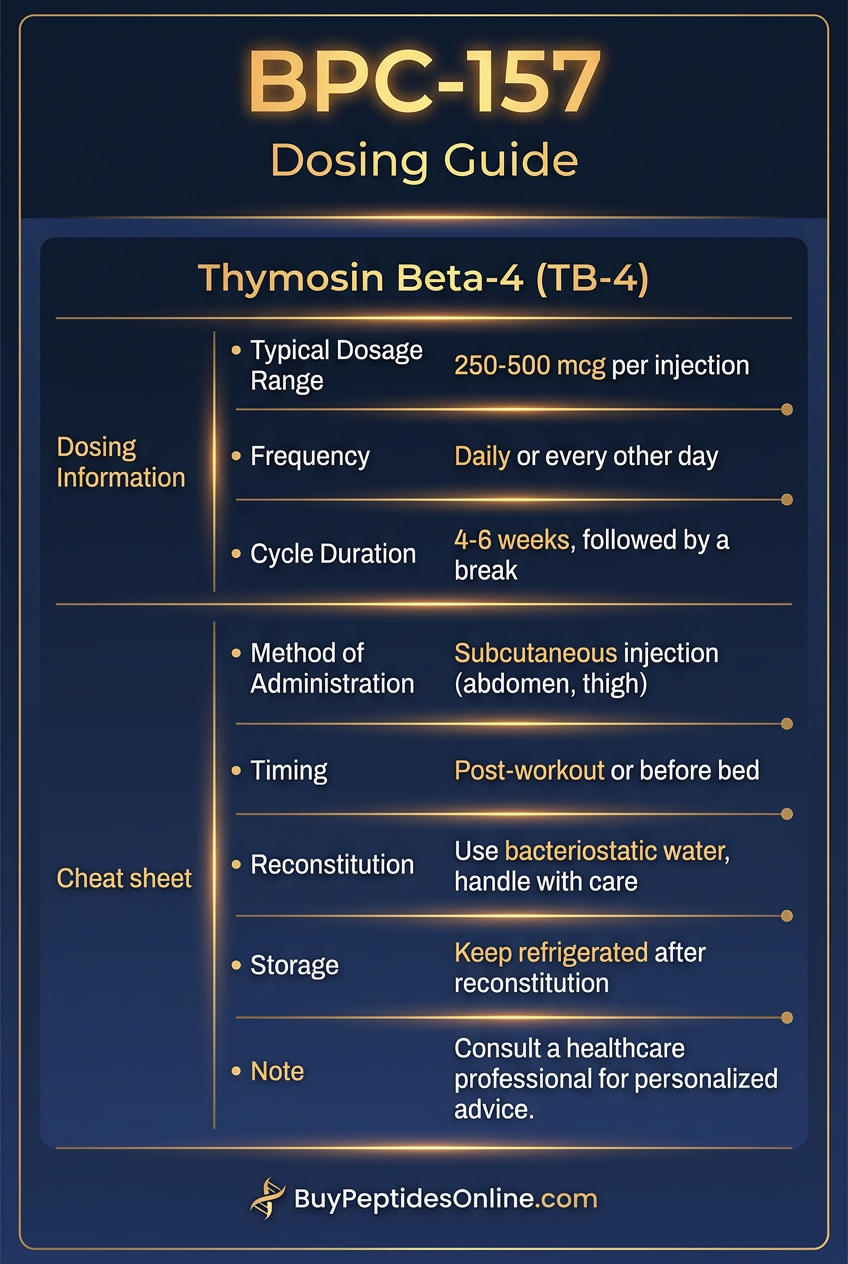
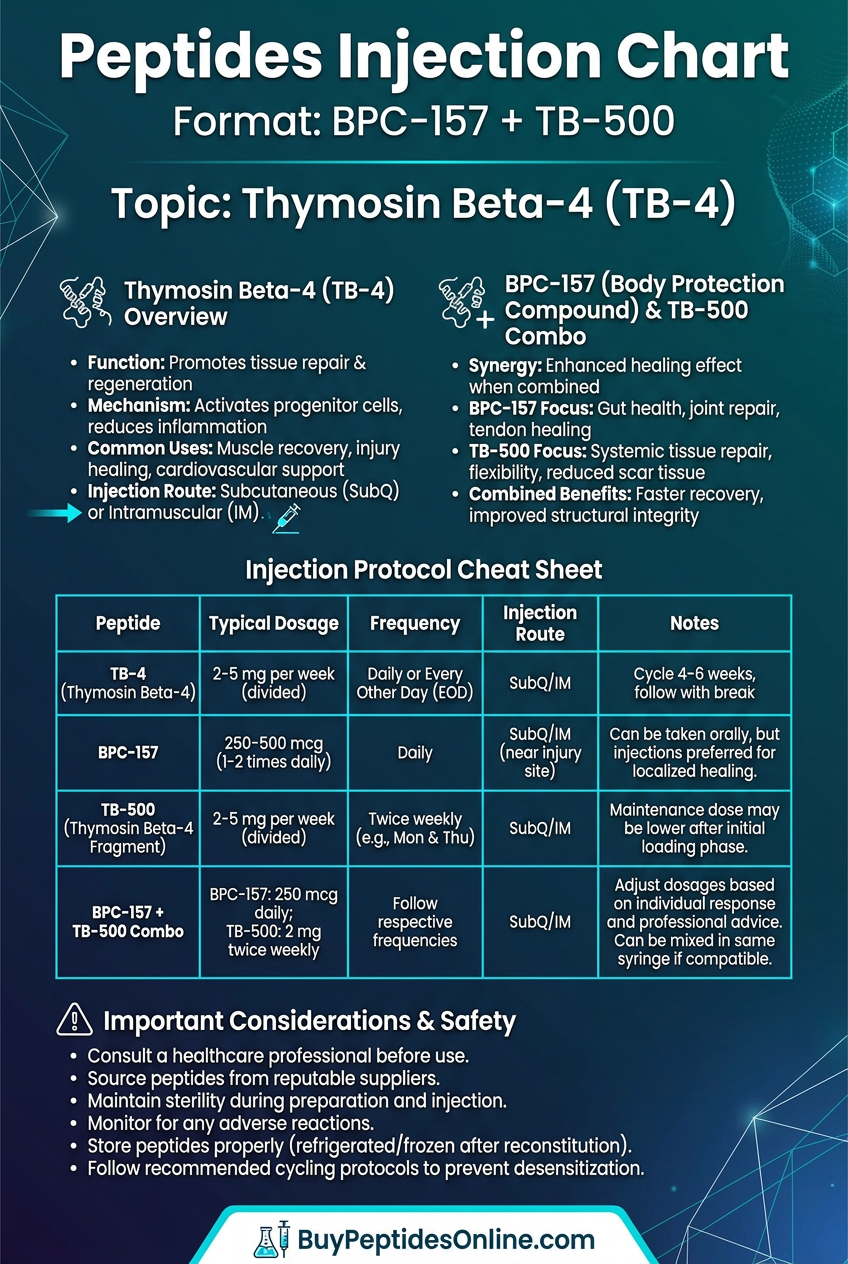
The following represents a synthesis of dosing parameters used in published research studies. These are provided for educational purposes only and do not constitute recommendations for human use.
| Protocol Context | Route | Dose | Frequency | Duration | Notes |
|---|---|---|---|---|---|
| Wound healing (preclinical) | SubQ | 250–500μg | 2x/week | 4 weeks | Monitor local tissue response |
| Standard tissue repair | IM | 1.0–1.5mg | 3x/week | 6–8 weeks | Consider hyaluronidase co-injection for dispersion |
| Cardiac ischemia (preclinical) | IV | 0.5mg/kg | Daily × 7 days, then 3x/week | 4 weeks | Perioperative protocols only |
| Neurological (intranasal) | Intranasal | 2.5mg/kg | Daily | 4 weeks | Divided into both nostrils |
| Topical (dermal) | Topical | 0.1% gel | Daily to BID | Until closure | Occlusive dressing enhances penetration |
Injection Technique Considerations
For subcutaneous injection, sites should be rotated systematically to prevent local tissue reactions. The abdomen, outer thigh, and lateral upper arm are commonly used rotation sites. Injection depth should be sufficient to reach the subcutaneous fat layer (typically 45° angle with a 25–27 gauge needle).
For intramuscular injection, the vastus lateralis (outer thigh) or deltoid are preferred sites. Some research protocols add hyaluronidase to the injection solution to improve peptide dispersal through the tissue matrix, potentially enhancing local bioavailability.
For intranasal administration, specialized nasal atomizer devices (MAD Nasal or similar) are preferred over simple dropper bottles, as they produce a fine mist that deposits on the olfactory epithelium rather than running into the nasopharynx. Administration in the head-down position (kneeling with forehead near the floor) maximizes contact with the olfactory region.
---
Stacking Strategies and Combination Protocols
The multi-pathway nature of TB-4's mechanism creates opportunities for rational combination with other research peptides that operate through complementary pathways. The following combinations have been studied or theoretically justified in the research literature:
TB-4 + BPC-157: The Comprehensive Healing Stack
This is the most studied and theoretically well-justified combination in the healing peptide space. TB-4 drives cellular migration and cytoskeletal remodeling while BPC-157 optimizes the vascular environment through nitric oxide-mediated mechanisms. In gut healing models, the combination has shown synergistic effects. A commonly studied protocol uses 2mg TB-4 (AM) combined with 500μg BPC-157 (PM), with the temporal separation intended to prevent potential competition for shared signaling pathways. For comprehensive guidance on this combination, see BPC-157 and TB-500 blend healing stack protocol.
TB-4 + GHK-Cu: Collagen Remodeling Optimization
GHK-Cu (copper peptide) promotes collagen synthesis, MMP regulation, and wound healing through mechanisms largely distinct from TB-4—primarily through copper-dependent enzyme activation and transcription factor modulation. The combination in a 1:2 ratio (TB-4:GHK-Cu by mass) has been proposed for applications where both cellular migration (TB-4) and matrix quality (GHK-Cu) are important, such as dermal wound healing and anti-aging skin applications. For more on GHK-Cu's independent properties, see buy GHK-Cu online pure copper peptides.
TB-4 + Thymosin Alpha-1: Immune-Repair Synergy
Thymosin alpha-1 modulates immune function through Toll-like receptor pathways and dendritic cell activation, while TB-4 handles the structural repair and anti-inflammatory aspects. In contexts where both immune dysregulation and tissue damage are present—such as autoimmune conditions, chronic infections, or post-viral syndromes—the combination may address both dimensions simultaneously. This stack has been discussed in the context of autoimmune conditions, and for broader context see best autoimmune peptides buy online immune support guide.
Post-Stroke Neurological Stack
For neurological applications, intranasal TB-4 combined with Cerebrolysin has been proposed based on complementary mechanisms: TB-4 drives axonal sprouting and synaptogenesis through cytoskeletal mechanisms, while Cerebrolysin provides neurotrophic factor-like support for neuronal survival and plasticity. Both compounds have demonstrated efficacy in stroke models individually; the combination has theoretical additive potential.
TB-4 + Epithalon: Longevity-Oriented Protocol
For researchers interested in the intersection of tissue repair and longevity biology, combining TB-4 with Epithalon has been discussed. Epithalon's primary mechanism involves telomerase activation and pineal gland regulation, while TB-4 addresses the structural repair and regenerative capacity aspects of aging. The combination targets different hallmarks of aging simultaneously—telomere attrition (Epithalon) and impaired tissue maintenance (TB-4). For broader context on longevity-oriented peptide combinations, see top longevity peptides 2026.
---
Safety Profile and Documented Side Effects
TB-4 has an unusually clean safety profile for a compound with such potent biological activity. This likely reflects the fact that it is a naturally occurring peptide present in virtually all human tissues—the body has evolved to handle it safely.
Commonly Reported Effects (5–15% of subjects in research contexts)
Transient hypotension: Mild blood pressure reduction, likely related to TB-4's vasodilatory effects through NO and VEGF pathways. Typically self-limiting and resolves within 1–2 hours of administration. Most prominent with IV administration and larger doses.
Injection site reactions: Erythema, mild swelling, and tenderness at subcutaneous or intramuscular injection sites. Usually resolves within 24–48 hours. Proper injection technique and site rotation minimize this.
Fatigue or lethargy: Some research subjects report mild fatigue in the hours following administration, possibly related to the acute hemodynamic effects or direct CNS actions.
Headache: Occasionally reported, particularly with intranasal administration. Usually mild and transient.
Rarely Reported Effects (<1%)
Autoantibody formation: Theoretical concern based on the principle that exogenous peptides can potentially serve as neoantigens. No clinical cases of anti-TB-4 autoantibodies causing pathology have been reported, but long-term immunological monitoring is advisable in extended research protocols.
Nausea: Occasionally reported with higher doses, mechanism unclear.
Dizziness: Related to transient hypotension, particularly with rapid IV administration.
Contraindications and Cautions
Active malignancy: The most significant safety concern with TB-4 is its potent angiogenic activity. VEGF upregulation and endothelial cell migration promotion could theoretically support tumor vascularization and growth in the presence of existing malignancy. This is not a theoretical concern unique to TB-4—it applies to all pro-angiogenic compounds. Research protocols involving TB-4 should exclude subjects with known or suspected malignancy.
Pregnancy and lactation: Insufficient safety data exists for these populations. TB-4's effects on fetal development and placental biology are unknown. Exclusion from research protocols involving pregnant or nursing subjects is appropriate.
Recent surgery near vascular structures: The angiogenic effects of TB-4 could theoretically complicate healing near major vessels or in vascular reconstruction contexts, though this remains theoretical.
Autoimmune conditions: While TB-4 has anti-inflammatory properties, its immune-modulatory effects in the context of active autoimmune disease are incompletely characterized. Caution is warranted.
Drug Interactions
TB-4's interaction with ACE inhibitors deserves specific mention. Because ACE degrades the Ac-SDKP fragment released from TB-4, ACE inhibitor use would be expected to prolong and amplify the effects of this biologically active fragment. Whether this represents a beneficial synergy or a source of unexpected effects is not well characterized.
The combination of TB-4 with other pro-angiogenic compounds (VEGF, FGF-2, PDGF) would be expected to produce additive angiogenic effects—potentially beneficial in ischemic tissue contexts but requiring careful monitoring.
---
Common Research Mistakes and How to Avoid Them
Mistake 1: Confusing TB-4 with TB-500
As discussed throughout this article, TB-4 and TB-500 are related but distinct compounds. Using them interchangeably in research protocols or literature interpretation leads to errors. Always clarify which compound is being used and what the expected differences in activity profile are.
Mistake 2: Inadequate Storage and Handling
TB-4 is stable when properly stored but degrades rapidly under suboptimal conditions. The most common errors include: storing reconstituted solution at room temperature for extended periods; using plain sterile water instead of bacteriostatic water for multi-dose vials; vortexing the solution vigorously during reconstitution; and exposing the peptide to repeated freeze-thaw cycles. Each of these errors reduces potency and can introduce degradation products with unpredictable biological activity.
Mistake 3: Expecting Rapid Visible Results
TB-4 operates primarily through cellular migration, proliferation, and differentiation—biological processes that unfold over days to weeks, not hours. Researchers expecting acute effects comparable to anti-inflammatory drugs or analgesics will be disappointed. The compound's value lies in accelerating and improving the quality of repair processes, which requires time to manifest as measurable outcomes.
Mistake 4: Ignoring the Angiogenic Contraindication
The VEGF-stimulating activity of TB-4 is not a minor footnote—it is a genuine safety consideration that should be taken seriously in research protocol design. Screening for malignancy before initiating TB-4 research protocols is not optional.
Mistake 5: Using Insufficient Dose Duration
The research literature consistently shows that TB-4's most significant effects emerge with sustained administration over 4–8 weeks, not short courses. Protocols shorter than 4 weeks are unlikely to capture the full regenerative effects, particularly for cardiac and neurological applications where the relevant biological processes (stem cell activation, axonal sprouting, synaptic remodeling) require extended time frames.
Mistake 6: Neglecting Baseline Measurements
TB-4's effects on cardiac function, wound healing rates, and neurological outcomes are best quantified against well-established baselines. Researchers who fail to measure relevant parameters before beginning protocols cannot meaningfully interpret their results.
---
Future Directions and Clinical Development
The REPAIR-AMI Trial
The most advanced clinical development program for TB-4 is the REPAIR-AMI phase III trial (NCT04224415), investigating intracoronary TB-4 administration following acute myocardial infarction. Early data suggests dose-dependent improvement in myocardial perfusion, and the trial represents the first large-scale human study of TB-4's cardiac effects. Results from this trial will be pivotal in determining whether the dramatic findings from preclinical models translate to clinical benefit in human patients.
Dry Eye Disease
As mentioned above, TB-4 has completed Phase II clinical trials for dry eye disease, with promising results. Phase III development is anticipated, and this indication may represent the first regulatory approval for TB-4 given the relatively favorable risk-benefit profile for topical ocular application and the large unmet medical need in this population.
Wound Care
The chronic wound care market—encompassing diabetic foot ulcers, venous leg ulcers, and pressure injuries—represents a multi-billion dollar opportunity with significant unmet need. TB-4's demonstrated efficacy in diabetic wound models positions it as a candidate for development in this space, though the regulatory pathway for wound healing indications is challenging.
Neurological Applications
Multiple sclerosis, stroke, and traumatic brain injury represent high-value targets for TB-4 development, but the neurological development path is long and expensive. The intranasal delivery route may simplify development by avoiding the need to demonstrate CNS penetration following systemic administration.
Combination Biologics
An emerging area of interest involves combining TB-4 with other regenerative biologics—including platelet-rich plasma (PRP), mesenchymal stem cell secretomes, and extracellular vesicles—to create synergistic repair platforms. TB-4's role as a cytoskeletal regulator and stem cell activator is complementary to the growth factor-rich environment provided by these other modalities.
Bioengineering Applications
TB-4 is being incorporated into tissue engineering scaffolds and hydrogels designed for implantable wound care and organ repair applications. Controlled-release formulations that deliver TB-4 over days to weeks from a biodegradable matrix may overcome the pharmacokinetic limitations of the free peptide and improve outcomes in surgical applications.
---
Who Is TB-4 Being Studied For?
Research into TB-4 spans an unusually broad range of potential applications, reflecting its multi-pathway mechanism:
Cardiovascular research: Post-MI recovery, chronic ischemic heart disease, heart failure, and cardiac surgery recovery are the primary cardiovascular research contexts. The potential to regenerate functional cardiomyocytes—if confirmed in human trials—would represent a paradigm shift in cardiology.
Wound care research: Diabetic ulcers, burns, surgical wounds, and chronic non-healing wounds are studied extensively. TB-4's ability to overcome the specific healing deficits of diabetic tissue (impaired FAK phosphorylation, reduced keratinocyte motility) is particularly relevant.
Neurological research: Stroke recovery, traumatic brain injury, multiple sclerosis, and potentially neurodegenerative diseases are active research areas. The intranasal delivery route has made CNS research more tractable.
Orthopedic and sports medicine research: Tendon injuries, muscle tears, ligament damage, and bone healing are studied, often using TB-500 as a cost-effective proxy for the full peptide.
Dermatology and aesthetics research: Wound healing, scar reduction, and hair loss are studied, with topical formulations being particularly relevant for these surface-accessible applications.
Ophthalmology research: Corneal wound healing and dry eye disease are the primary ocular applications, with the most advanced clinical development program.
---
Frequently Asked Questions
What is the difference between TB-4 and TB-500?
TB-4 is the complete 43-amino acid peptide (thymosin beta-4), while TB-500 is a synthetic fragment corresponding to residues 17–23 of TB-4 (the sequence LKKTETQ, also called the actin-binding domain or WH2 domain). TB-500 retains the core actin-regulatory and cell migration-promoting activities of the full peptide but lacks the additional functional domains responsible for TB-4's anti-inflammatory signaling, cardiac progenitor activation, and Ac-SDKP release. For musculoskeletal healing research where cost is a consideration, TB-500 is a reasonable proxy. For cardiac, neurological, or comprehensive regenerative applications, the full TB-4 peptide is preferable. The TB-500 dosage protocol guide provides detailed information on the fragment's specific applications.
How should TB-4 be reconstituted and stored?
Lyophilized TB-4 should be reconstituted by slowly adding bacteriostatic water (for multi-dose use) or sterile water (for single-dose use) along the inner wall of the vial—never inject directly onto the powder. Gently swirl until dissolved; do not shake or vortex. A standard working concentration is 5mg/ml (1ml per 5mg vial). Reconstituted solution should be stored at 4°C for up to 72 hours, or aliquoted and frozen at −20°C for up to 30 days. Lyophilized powder should be stored at −20°C and is stable for up to 24 months when properly maintained. Protect all formulations from light and avoid repeated freeze-thaw cycles.
Is TB-4 safe for research use?
TB-4 is a naturally occurring peptide present in virtually all mammalian tissues, and its safety profile in preclinical studies has been favorable. Common adverse effects in research contexts include transient mild hypotension, injection site reactions, and occasional fatigue—all typically self-limiting. The most significant safety consideration is the peptide's pro-angiogenic activity (VEGF upregulation), which represents a theoretical concern in the context of malignancy. Research protocols should exclude subjects with active or suspected malignancy. Pregnancy and lactation are also considered contraindications due to insufficient safety data. This information is provided for educational purposes; TB-4 is not an approved drug, and all research use should comply with applicable regulations and institutional oversight requirements.
Can TB-4 be combined with other peptides?
Yes, and rational combination protocols have been studied in the research literature. The most established combination is TB-4 with BPC-157, which targets complementary mechanisms—TB-4's cytoskeletal and stem cell activation effects complement BPC-157's nitric oxide-mediated vascular effects. TB-4 has also been combined with GHK-Cu for dermal applications targeting both cellular migration (TB-4) and matrix quality (GHK-Cu). For neurological applications, combination with Cerebrolysin has been proposed. When combining peptides, researchers should consider potential pharmacokinetic interactions, additive pro-angiogenic effects, and the practical challenges of managing multiple compound administrations.
What makes TB-4 unique compared to growth factors like PDGF or FGF-2?
TB-4 differs from protein growth factors in several important ways. Its small size (4,963 Da vs. 15,000–40,000 Da for growth factors) allows superior tissue penetration and systemic distribution following a single injection. It has a much longer half-life than most growth factors (2.5 hours vs. 15 minutes for PDGF). It is significantly less expensive to produce. Critically, TB-4 combines pro-repair activity with anti-inflammatory effects—most growth factors are either neutral or pro-inflammatory, which can cause tissue damage alongside their repair-promoting effects. TB-4 also activates stem cell populations that growth factors do not, potentially enabling true tissue regeneration rather than merely accelerated scar formation.
How long does it take to see research effects with TB-4?
TB-4 operates through biological processes—cellular migration, proliferation, differentiation, and matrix remodeling—that unfold over days to weeks. Acute effects on cellular migration can be measured within 24 hours in vitro. In wound healing models, accelerated closure is typically measurable within 3–7 days. For cardiac and neurological applications, meaningful functional improvements emerge over 2–4 weeks and continue to develop over the full treatment course and beyond. Research protocols shorter than 4 weeks are unlikely to capture the full scope of TB-4's regenerative effects, particularly for the more complex tissue regeneration endpoints.
What is the current clinical development status of TB-4?
TB-4 is in active clinical development through several programs. The most advanced is the REPAIR-AMI phase III trial (NCT04224415) investigating intracoronary TB-4 following acute myocardial infarction. Phase II trials for dry eye disease have been completed with promising results, and Phase III development is anticipated for this indication. Phase I/II trials have been conducted for pressure ulcers and other wound healing indications. TB-4 remains an investigational compound and is not approved as a drug in any jurisdiction. All clinical development programs are conducted under appropriate regulatory oversight with institutional review board approval.
---
Key Takeaways
TB-4 is the only peptide with robust preclinical evidence for functional cardiomyocyte regeneration: , operating through epicardial progenitor cell activation rather than simple cardioprotection
Its multi-pathway mechanism: —G-actin sequestration, anti-inflammatory signaling, angiogenesis, stem cell activation, and anti-apoptotic signaling—makes it uniquely versatile across tissue types
The Ac-SDKP fragment: released from TB-4 by prolyl oligopeptidase has independent anti-fibrotic and anti-inflammatory activity, connecting TB-4 biology to ACE inhibitor pharmacology
TB-4 and TB-500 are related but distinct: ; the fragment retains core actin-regulatory activity but lacks the full peptide's cardiac, inflammatory, and stem cell functions
Topical TB-4 formulations: overcome diabetes-specific healing deficits by restoring FAK phosphorylation, making it particularly relevant for chronic wound research
Intranasal delivery: achieves meaningful CNS concentrations and has demonstrated neurological effects including axonal sprouting and synaptogenesis in stroke models
The primary safety concern: is pro-angiogenic activity (VEGF upregulation), which contraindicates use in the presence of active malignancy
Pulsed dosing protocols: (2–3x weekly) are supported by the pharmacokinetic profile and appear to produce more robust biological responses than continuous administration
The REPAIR-AMI Phase III trial: represents the most advanced human clinical program and will provide critical translational data
Rational combination: with BPC-157, GHK-Cu, and Cerebrolysin targets complementary mechanisms for comprehensive tissue repair applications
---
Continue Your Peptide Research
🔬 Explore our peptide database — Browse 500+ research peptide profiles with mechanisms of action, dosing protocols, and clinical evidence summaries.
🤖 Have questions? — Ask PeptideAI, our research assistant, for personalized peptide guidance based on the latest studies.
📚 Want more guides? — Browse all research articles covering peptide science, comparisons, and buying guides.
Related Articles
Continue your research with these in-depth guides: