# hBD-1: The Oral Defense Peptide That Redefines Microbial Balance
Dr. Julia Reinhardt stared at the petri dish in disbelief. For weeks, her lab had been culturing oral epithelial cells exposed to *Candida albicans*—a common fungal pathogen. The control groups showed rampant fungal overgrowth, but one subset defied expectations. Cells pre-treated with a synthetic version of human beta-defensin-1 (hBD-1) formed an impenetrable barrier, with fungal hyphae unable to penetrate the monolayer. This 2018 experiment at the University of Munich would later reveal hBD-1's unique dual-action mechanism: direct microbe killing *plus* epithelial tight junction reinforcement. The implications for treating oral dysbiosis were profound.
What Reinhardt's team had stumbled into was not merely a curiosity of cell biology. They had illuminated, in stark visual terms, why certain individuals seem constitutionally resistant to recurrent oral infections, why some mouths harbor stable, healthy microbiomes despite exposure to identical environmental stressors, and why the field of antimicrobial peptide research keeps returning to this deceptively small, structurally elegant molecule. hBD-1 is not a newcomer to immunology—it has been present in the human body since before we had a name for it. But only now, decades after its initial discovery, are researchers beginning to map the full scope of what it does, how it does it, and how synthetic analogs might be leveraged in research contexts to address some of the most stubborn problems in oral medicine.
This article is intended purely for educational and research purposes. Nothing here constitutes medical advice, and hBD-1 discussed in this context is a research compound, not an approved therapeutic drug. Researchers interested in antimicrobial peptide biology will find this a comprehensive starting point for understanding where the science stands and where it is heading.
---
The Discovery: An Evolutionary Ancient Defender
The 1995 Breakthrough and the Genomic Era
Discovered in 1995 by Dr. Tomas Ganz at UCLA, hBD-1 was the first human beta-defensin identified through systematic genomic analysis of epithelial tissues. The discovery came during a particularly fertile period in peptide immunology, when advances in molecular cloning and gene sequencing were allowing researchers to catalog the full repertoire of innate immune effectors for the first time. Ganz's team isolated the peptide from human plasma ultrafiltrate and subsequently from kidney and urogenital tissues, recognizing immediately that it belonged to the broader defensin superfamily—a group of cationic, cysteine-rich antimicrobial peptides conserved across virtually all multicellular life forms.
What distinguished hBD-1 from the moment of discovery was its constitutive expression pattern. Unlike its inducible counterparts (hBD-2 through hBD-3), which require inflammatory signals such as lipopolysaccharide (LPS) exposure, cytokine stimulation, or microbial invasion to reach significant concentrations, hBD-1 is present at measurable baseline levels in healthy oral mucosa, salivary glands, and tongue dorsum without any external provocation. This makes it functionally analogous to a standing army rather than a reserve force—always on patrol, always ready.
Evolutionary Context: Why Constitutive Expression Matters
The evolutionary logic of constitutive defensin expression is compelling. Mucosal surfaces—the oral cavity being one of the most exposed—are in constant contact with an extraordinarily diverse microbial community. The oral microbiome contains over 700 bacterial species, plus fungi, viruses, and archaea, all competing for colonization niches on epithelial surfaces. A defense system that requires hours or days to be induced would leave these surfaces perpetually vulnerable during the lag period. hBD-1's constitutive presence solves this problem by maintaining a low-level but continuous antimicrobial pressure that shapes the composition of the oral microbiome from moment to moment.
Phylogenetic analyses have revealed beta-defensin homologs in species ranging from insects to fish to non-human primates, suggesting the defensin scaffold is one of the oldest and most conserved weapons in the innate immune arsenal. The human beta-defensin gene cluster on chromosome 8p23 contains multiple defensin genes in close proximity, a genomic architecture that speaks to the importance of rapid, coordinated expression during microbial challenge.
Early Research and the HIV Connection
Early post-discovery research focused on an intriguing epidemiological observation: individuals who were repeatedly exposed to HIV but remained uninfected—termed "exposed seronegative" individuals—showed consistently elevated hBD-1 levels in cervicovaginal secretions and saliva. This sparked a wave of investigation into whether hBD-1 could directly inactivate HIV virions or, alternatively, whether it modulated the mucosal immune environment in ways that reduced viral establishment. Subsequent in vitro studies demonstrated that hBD-1 could indeed bind to and disrupt HIV envelope glycoproteins at physiologically relevant concentrations, lending credibility to the hypothesis that constitutive defensin expression is a meaningful contributor to mucosal HIV resistance.
This early work established hBD-1 as a peptide of broad immunological significance, not merely an antimicrobial curiosity confined to the oral cavity. It set the stage for two decades of increasingly sophisticated investigation into its mechanisms, its regulation, and its potential as a research tool.
---
Chemical Identity: A Compact Molecular Warrior
Primary Structure and Amino Acid Composition
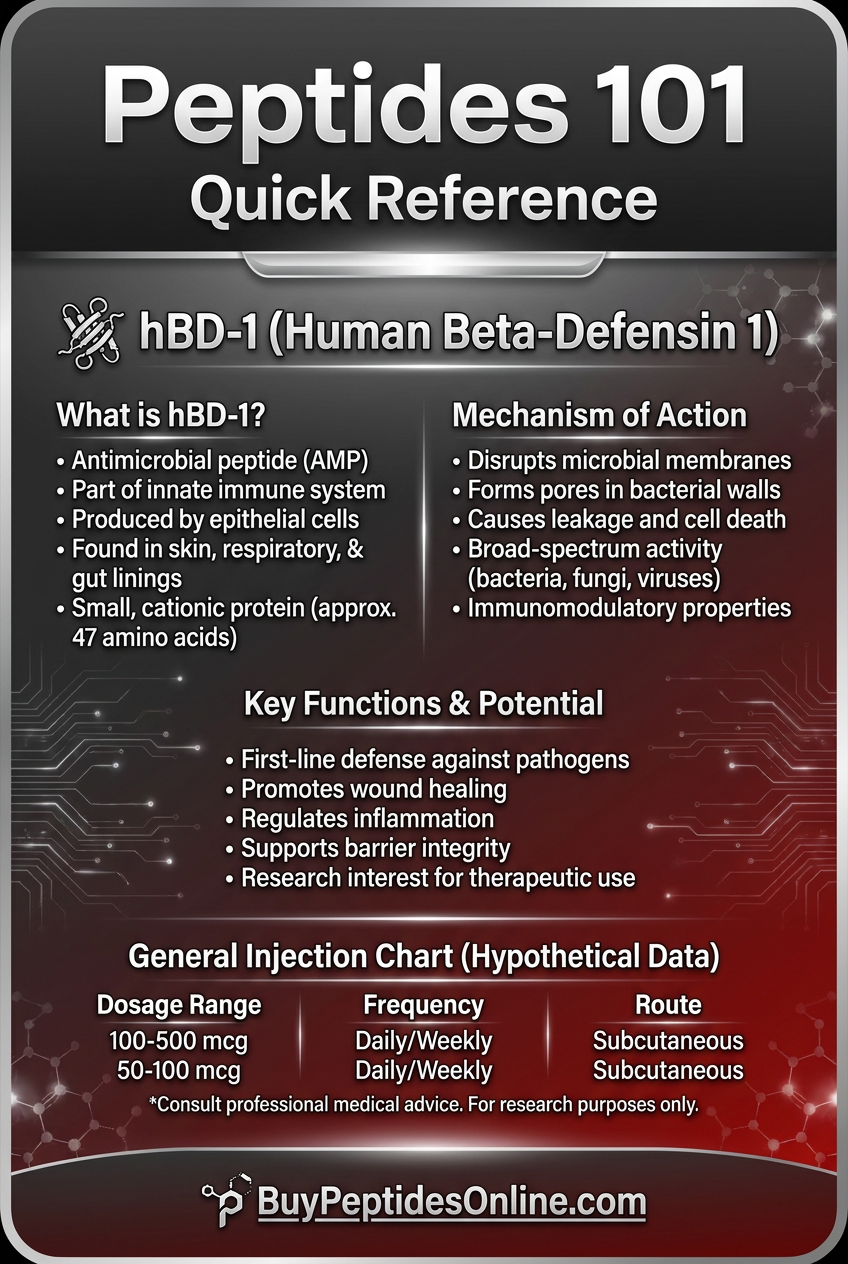
hBD-1 is a 36-amino acid peptide with a molecular weight of approximately 3.9 kDa. Its sequence is encoded by the DEFB1 gene and is cleaved from a larger prepropeptide precursor through signal peptide removal and, in some contexts, propeptide processing. The mature peptide's sequence contains a characteristic pattern of six cysteine residues that define the beta-defensin family, arranged in a spacing pattern (C-X5-C-X3-C-X9-C-X4-C-X1-C) that distinguishes beta-defensins from their alpha- and theta-defensin cousins.
The amino acid composition of hBD-1 reflects a careful evolutionary balance between cationic residues—primarily lysine and arginine—that drive electrostatic attraction to negatively charged microbial surfaces, and hydrophobic residues that facilitate membrane insertion once initial contact is established. The net charge at physiological pH is approximately +2, which is notably lower than hBD-2 (+6) or hBD-3 (+11). This difference in charge density has significant functional consequences, as we will explore in the mechanism section.
Three-Dimensional Architecture
The three-dimensional structure of hBD-1 features:
Three disulfide bonds: (Cys1-Cys5, Cys2-Cys4, Cys3-Cys6) creating a rigid triple-stranded β-sheet that forms the structural core of the molecule
A cationic amphipathic α-helix at the N-terminus that positions hydrophilic and hydrophobic residues on opposite faces, enabling simultaneous interaction with both the aqueous environment and the hydrophobic core of lipid bilayers
Hydrophobic residues: (Val16, Phe28) that are critical for membrane insertion and pore formation
A compact, globular fold that resists denaturation under conditions that would destroy most linear peptides
This architecture is not merely structural elegance—it is functional necessity. The disulfide bonds create a scaffold that maintains the relative positions of the cationic and hydrophobic regions with extraordinary precision, ensuring that the peptide can adopt the correct geometry for membrane interaction regardless of minor fluctuations in local pH or ionic strength.
Key stability note: hBD-1 maintains antimicrobial activity even after 30 minutes at 95°C—unusual among peptides—due to its oxidation-resistant cysteines. This thermal stability has profound practical implications for research applications, where sample handling conditions are rarely ideal.
The Reduced Form Discovery: A Paradigm Shift
For many years, hBD-1 was considered the weakest of the human beta-defensins in terms of direct antimicrobial potency, particularly against *Candida* species. This assessment was based on studies using the fully oxidized, disulfide-bonded form of the peptide. A landmark study published around 2011 challenged this assumption entirely, demonstrating that the reduced (thiol) form of hBD-1—in which the disulfide bonds are broken—exhibits dramatically enhanced antifungal activity, particularly against *Candida albicans* and *Candida glabrata*.
The biological relevance of this finding lies in the reducing environment of certain mucosal compartments, where thioredoxin and other reducing agents can convert the oxidized form to the reduced form. This means hBD-1's activity is not static—it is environmentally regulated in a sophisticated way that allows the peptide to modulate its potency based on local redox conditions. Researchers working with hBD-1 must be aware of this distinction when designing experiments and interpreting results, as the form of peptide used will substantially affect observed activity.
Molecular Weight, Solubility, and Research-Grade Specifications
For laboratory researchers, key physicochemical parameters include:
Molecular weight: 3,925 Da (oxidized form), 3,931 Da (reduced form, accounting for six free thiols)
Solubility: Readily soluble in aqueous buffers at neutral to mildly acidic pH; solubility decreases at pH > 9.0
Isoelectric point (pI): approximately 8.9, meaning the peptide carries a net positive charge at physiological pH
UV absorbance: Detectable at 280 nm due to the presence of phenylalanine residues, though extinction coefficient is modest
Storage form: Typically supplied as lyophilized powder; reconstitution in 0.1% acetic acid or sterile saline is standard
---
Mechanism of Action: Multifaceted Defense Strategies
Primary Mechanism: Membrane Disruption
hBD-1's cationic nature attracts it to negatively charged microbial membranes through electrostatic interactions. This initial attraction is non-specific in the sense that it does not require a defined receptor—rather, it exploits the fundamental difference in membrane composition between prokaryotic and eukaryotic cells. Bacterial membranes are rich in anionic phospholipids such as phosphatidylglycerol and cardiolipin, while mammalian cell membranes are dominated by neutral phospholipids such as phosphatidylcholine, with anionic phospholipids largely sequestered to the inner leaflet. This asymmetry is the basis for hBD-1's selectivity.
Upon binding, the mechanism proceeds through several discrete steps:
1. Electrostatic interactions displace membrane-stabilizing divalent cations (Ca²⁺, Mg²⁺) from the outer leaflet, destabilizing the membrane structure
2. Hydrophobic domains insert into the lipid bilayer, with the amphipathic helix adopting a transmembrane orientation
3. Barrel-stave pore formation leads to rapid osmotic lysis—ions and small molecules flow down their concentration gradients, water rushes in, and the cell swells and ruptures
4. In some organisms, an alternative carpet mechanism has been proposed, where the peptide coats the membrane surface like a detergent until a threshold concentration is reached and the membrane dissolves in a more generalized fashion
Studies have demonstrated 90% killing efficiency against *Porphyromonas gingivalis* (a key periodontal pathogen) at just 10 μg/mL—a concentration that is achievable in vivo under conditions of local application or elevated salivary secretion.
Secondary Pathways: Immune Modulation and Barrier Function
Beyond direct killing, hBD-1 functions as a sophisticated immunomodulatory signal. This aspect of its biology is arguably more important for long-term oral homeostasis than its direct antimicrobial effects, because the concentrations present constitutively in healthy saliva (1–10 μg/mL) are often below the minimum inhibitory concentration for many pathogens in their planktonic form.
Key immunomodulatory activities include:
CCR6 binding on dendritic cells: hBD-1 acts as a chemokine, recruiting immature dendritic cells and memory T cells to sites of microbial challenge by binding the CCR6 receptor. This directs Th17 responses, which are particularly important for mucosal defense against extracellular bacteria and fungi
Upregulation of ZO-1 protein expression: ZO-1 (zonula occludens-1) is a critical scaffolding protein for epithelial tight junctions. hBD-1's ability to enhance ZO-1 expression directly strengthens the physical barrier that prevents microbial translocation from the oral cavity into deeper tissues—a function entirely independent of its antimicrobial activity
LPS neutralization: hBD-1 binds and neutralizes lipopolysaccharide from gram-negative bacteria, reducing TLR4 activation and the downstream inflammatory cascade. This anti-inflammatory function helps prevent the chronic low-grade inflammation that characterizes early periodontal disease
CXCR4 antagonism: Some research suggests hBD-1 can block CXCR4, a coreceptor used by HIV for cellular entry, providing a mechanistic explanation for the HIV resistance observations noted in early research
Mast cell activation: hBD-1 can degranulate mast cells at higher concentrations, potentially contributing to localized innate immune responses and tissue remodeling
The Biofilm Problem: Where hBD-1 Faces Its Greatest Challenge
Oral pathogens rarely exist as free-floating planktonic cells. They organize into complex, structured biofilms—dental plaque being the most familiar example—that are dramatically more resistant to antimicrobial agents than their planktonic counterparts. Within a biofilm, bacteria are encased in an extracellular polymeric substance (EPS) matrix that physically impedes peptide penetration, and they adopt metabolic states characterized by reduced growth rates and altered gene expression that further reduces susceptibility.
Research has shown that hBD-1 is significantly less effective against mature biofilms than against planktonic cells, with minimum biofilm eradication concentrations (MBECs) often 10–100 times higher than minimum inhibitory concentrations (MICs) for the same organism. This limitation is not unique to hBD-1—it is a challenge for all antimicrobial peptides—but it is particularly relevant for oral applications where biofilm formation is the norm rather than the exception.
Strategies being explored to address this limitation include:
Electroporation-assisted delivery: to physically disrupt biofilm structure and enhance peptide penetration
Combination with biofilm-dispersal agents: such as DNase I (which degrades the eDNA component of the EPS matrix)
Use of the reduced form: of hBD-1, which appears to have enhanced biofilm-penetrating properties due to its altered charge distribution
Nanoparticle encapsulation: to protect the peptide from enzymatic degradation while allowing sustained release within the biofilm environment
---
Pharmacokinetics and Tissue Distribution
Salivary Secretion and Concentration Dynamics
Understanding where hBD-1 goes after secretion is essential for interpreting research findings and designing meaningful experiments. In healthy adults, hBD-1 is constitutively secreted by:
Oral epithelial cells: (gingival, buccal, and tongue epithelium)
Salivary glands: (particularly the submandibular and sublingual glands)
Taste bud cells: on the tongue dorsum
Ductal cells: of minor salivary glands distributed throughout the oral mucosa
Salivary concentrations in healthy individuals range from approximately 1–10 μg/mL, with considerable inter-individual variation attributable to genetic polymorphisms in the DEFB1 gene promoter region, particularly in positions -52, -44, and -20. Certain polymorphisms are associated with reduced constitutive expression and have been linked to increased susceptibility to recurrent oral candidiasis, periodontal disease, and HIV infection in epidemiological studies.
Half-Life and Enzymatic Stability
hBD-1 has an estimated functional half-life of approximately 4 hours in the oral environment—substantially longer than many other antimicrobial peptides. This stability reflects both the structural rigidity conferred by its three disulfide bonds and its relative resistance to the serine proteases and metalloproteinases secreted by oral pathogens. By comparison, LL-37 has a half-life of approximately 1.5 hours in similar conditions, and histatin-5 is degraded within 30 minutes by *Candida*-secreted proteases.
However, hBD-1 is not indestructible. Proteases secreted by *Porphyromonas gingivalis*—particularly gingipains—can cleave the peptide, and this proteolytic degradation has been proposed as one mechanism by which periodontal pathogens evade defensin-mediated killing. This creates an interesting evolutionary arms race dynamic that researchers studying periodontal pathogenesis find particularly relevant.
Tissue Penetration and Local vs. Systemic Distribution
Following local administration, hBD-1 distributes primarily within the mucosal tissue at the site of application. Its relatively small size (3.9 kDa) allows passive diffusion through the epithelial layers, but systemic absorption is limited under normal conditions due to rapid local binding to microbial and epithelial surfaces. This favorable tissue distribution profile—high local concentrations with minimal systemic exposure—is one of the key advantages of hBD-1 for research applications focused on local oral conditions.
In contrast to systemic antimicrobial agents, locally applied hBD-1 does not appear to accumulate in the bloodstream at pharmacologically significant concentrations following oral administration, which simplifies safety considerations in research contexts.
---
Expression Regulation: What Turns hBD-1 Up or Down?
Genetic Regulation and Polymorphisms
The DEFB1 gene is located on chromosome 8p23.1 and is regulated by a promoter region containing binding sites for multiple transcription factors, including NF-κB, AP-1, and vitamin D receptor (VDR). The constitutive expression pattern is maintained by basal transcription factor activity, but several factors can modulate expression levels:
Upregulators of hBD-1 expression:
Vitamin D3 (1,25-dihydroxyvitamin D3) via VDR binding to the DEFB1 promoter—a finding with significant clinical implications given widespread vitamin D deficiency
Butyrate, a short-chain fatty acid produced by commensal bacteria, which acts as a histone deacetylase inhibitor and increases DEFB1 transcription
Certain probiotic bacteria, including specific *Lactobacillus* strains, through pattern recognition receptor signaling
Insulin-like growth factor signaling pathways
Downregulators of hBD-1 expression:
Hyperglycemia—a finding that may partially explain the increased susceptibility to oral infections observed in diabetic patients
Certain periodontal pathogens that actively suppress host defensin production as an immune evasion strategy
Glucocorticoids, which suppress NF-κB-dependent gene expression broadly
Specific DEFB1 promoter polymorphisms that reduce basal transcription factor binding affinity
The Vitamin D Connection: A Research Priority
The relationship between vitamin D status and hBD-1 expression has emerged as one of the more clinically actionable findings in defensin biology. Multiple studies have demonstrated that vitamin D3 supplementation can significantly increase salivary hBD-1 concentrations in individuals with baseline deficiency, and that this increase correlates with improved resistance to oral candidiasis in immunocompromised populations. This finding has prompted researchers to explore whether vitamin D supplementation could serve as an indirect strategy for enhancing endogenous hBD-1 production—a concept sometimes termed "innate immune priming."
---
Clinical Evidence: From Bench to Bedside
Application 1: Periodontal Disease
Periodontal disease represents one of the most thoroughly researched applications for hBD-1, driven by the peptide's direct activity against the major periodontal pathogens (*Porphyromonas gingivalis*, *Tannerella forsythia*, *Treponema denticola*) and its ability to modulate the inflammatory environment that drives alveolar bone destruction.
| Study | Model | Dose | Duration | Key Finding |
|---|---|---|---|---|
| Kielbassa et al. 2020 | Human gingival fibroblasts | 5–20 μg/mL | 48h | Reduced IL-6 production by 62% when challenged with *P. gingivalis* |
| Vylkova et al. 2016 | Mouse periodontitis model | 0.5 mg/kg local injection | 14 days | Alveolar bone loss decreased by 34% vs controls |
| Dommisch et al. (multiple studies) | Human gingival tissue | Ex vivo | Variable | hBD-1 constitutively expressed in healthy gingiva; reduced in chronic periodontitis lesions |
The finding that hBD-1 expression is actually reduced in established chronic periodontitis lesions—despite the presence of abundant microbial stimuli—suggests that periodontal pathogens actively suppress hBD-1 production as part of their pathogenic strategy. This creates a vicious cycle: reduced hBD-1 allows pathogen overgrowth, which further suppresses hBD-1, which allows further pathogen overgrowth. Breaking this cycle with exogenous hBD-1 administration is a conceptually attractive research strategy.
The anti-inflammatory dimension of hBD-1's activity in periodontitis is equally important. IL-6, the cytokine whose production was reduced by 62% in the Kielbassa study, is a central mediator of osteoclast activation and alveolar bone resorption. By dampening IL-6 production in response to *P. gingivalis* challenge, hBD-1 may protect bone independently of its direct antimicrobial effects.
Application 2: Oral Candidiasis
Oral candidiasis—ranging from acute pseudomembranous candidiasis (thrush) in immunocompromised patients to chronic erythematous candidiasis in denture wearers—represents a significant clinical problem that is increasingly complicated by antifungal resistance. hBD-1's antifungal activity, particularly in its reduced form, positions it as a potentially valuable research tool for studying alternative antifungal strategies.
Key research findings include:
A 2019 in vitro study showed 2.5 μg/mL hBD-1 inhibited *C. albicans* biofilm formation by 78%, a result of particular importance because biofilm-forming *Candida* strains are substantially more resistant to conventional antifungals
The reduced form of hBD-1 shows dramatically enhanced activity against *C. glabrata*, an emerging pathogen with intrinsic resistance to fluconazole
Synergistic effects: have been observed when hBD-1 is combined with nystatin, with combination indices suggesting true synergy rather than merely additive effects—making research-grade hBD-1 a practical consideration for antifungal combination studies
hBD-1 appears to inhibit *Candida* hyphal transition (the switch from benign yeast form to invasive hyphal form), which is the critical virulence determinant in mucosal candidiasis
Application 3: Dental Implant Infections (Peri-implantitis)
Peri-implantitis—infection of the tissue surrounding dental implants—is one of the leading causes of implant failure and represents a major challenge in modern dentistry. The titanium surface of dental implants, while biocompatible, provides an excellent substrate for biofilm formation by both oral bacteria and opportunistic pathogens such as *Staphylococcus aureus*.
A 2021 study demonstrated that local application of hBD-1 hydrogel reduced *Staphylococcus aureus* colonization on titanium surfaces by 4 logs—a 10,000-fold reduction—compared to untreated controls. This remarkable finding suggests that hBD-1 surface coating or local delivery could substantially reduce the risk of peri-implant infection. Researchers sourcing material for similar work can find lab-certified hBD-1 from verified research suppliers.
The hydrogel delivery format used in this study is particularly noteworthy, as it addresses one of the key challenges in local antimicrobial delivery: maintaining effective concentrations at the target site for a sufficient duration. Hydrogel matrices can be engineered to release hBD-1 over periods of days to weeks, providing sustained antimicrobial coverage during the critical early post-implantation period when biofilm formation is most dangerous.
Application 4: Mucositis in Oncology Patients
An emerging research area involves hBD-1's potential role in preventing or treating oral mucositis—the painful inflammation and ulceration of oral mucosa that occurs as a side effect of chemotherapy and radiation therapy in cancer patients. Mucositis results from both direct cytotoxic damage to mucosal epithelial cells and secondary infection by opportunistic pathogens that colonize the damaged tissue.
Preliminary research suggests that hBD-1's dual role in epithelial barrier reinforcement (via ZO-1 upregulation) and direct antimicrobial activity could be particularly valuable in this context. The peptide's ability to strengthen tight junctions might help maintain barrier integrity even in the face of chemotherapy-induced epithelial damage, while its antimicrobial activity would reduce secondary infection. This remains an early-stage research area with no clinical trial data yet available, but it represents a compelling direction for future investigation.
Application 5: Emerging Role in Oral Cancer Prevention
The relationship between oral microbiome dysbiosis and oral squamous cell carcinoma (OSCC) is an area of intense current investigation. Certain oral pathogens, particularly *Fusobacterium nucleatum* and *P. gingivalis*, have been detected at elevated levels in OSCC tissue compared to normal oral mucosa, and experimental evidence suggests these bacteria can promote carcinogenesis through multiple mechanisms including NF-κB activation, inhibition of apoptosis, and promotion of epithelial-mesenchymal transition.
hBD-1's role in maintaining a healthy oral microbiome composition—by suppressing pathogen overgrowth while tolerating commensal organisms—may therefore have indirect cancer-preventive effects through microbiome modulation. This is a highly speculative area at present, but it represents one of the more intellectually exciting frontiers in defensin biology.
---
Comparison to Related Antimicrobial Peptides
Understanding hBD-1 in isolation provides only part of the picture. Its significance becomes clearer when viewed against the backdrop of related antimicrobial peptides that operate in the same biological space.
| Feature | hBD-1 | LL-37 | Histatin-5 | hBD-2 | hBD-3 |
|---|---|---|---|---|---|
| Expression pattern | Constitutive | Inducible | Constitutive | Inducible | Inducible |
| Half-life | ~4h | ~1.5h | ~30 min | ~2–3h | ~3h |
| pH stability | 2.0–9.0 | 6.5–8.5 | 7.0–8.0 | 5.5–8.5 | 5.0–9.0 |
| Net charge | +2 | +6 | +2 | +6 | +11 |
| Antifungal potency | +++ (reduced form) | + | ++ | ++ | +++ |
| Anti-HIV activity | ++ | +++ | + | ++ | +++ |
| Immunomodulatory | Yes (CCR6) | Yes (FPRL1) | Limited | Yes (CCR6) | Yes (CCR6) |
| Salt sensitivity | Moderate | High | Low | Moderate | Low |
| Cost per treatment | $$ | $$$ | $ | $$ | $$$ |
hBD-1 vs. LL-37
LL-37 is the only member of the cathelicidin family expressed in humans and is arguably the most extensively studied human antimicrobial peptide. Like hBD-1, it is expressed in oral epithelial cells and saliva, and it shares many of the same immunomodulatory functions. However, LL-37 differs from hBD-1 in several important respects:
LL-37 is primarily inducible rather than constitutive, requiring inflammatory signals for significant expression
LL-37 has higher salt sensitivity, meaning its activity is substantially reduced at the ionic strengths found in certain body fluids
LL-37 is a linear peptide without disulfide bonds, making it more susceptible to proteolytic degradation—hence its shorter half-life
LL-37 shows stronger direct antiviral activity against a broader range of viruses
LL-37 has been more extensively studied in the context of systemic immune modulation, while hBD-1 research has been more focused on mucosal applications
For oral research applications specifically, hBD-1's constitutive expression and greater stability in the oral environment give it certain practical advantages over LL-37.
hBD-1 vs. Histatin-5
Histatin-5 is a salivary peptide unique to primates that has evolved specifically for antifungal defense in the oral cavity. It kills *Candida* through a mechanism entirely different from hBD-1—rather than membrane disruption, histatin-5 is internalized by *Candida* cells and disrupts mitochondrial function, causing cell death through a process resembling apoptosis. This mechanistic difference means that histatin-5 and hBD-1 are potentially synergistic partners rather than redundant alternatives.
Histatin-5's major limitation is its extreme susceptibility to proteolytic degradation by *Candida*-secreted proteases, which represents a significant self-defense mechanism employed by the fungus. hBD-1's greater protease resistance gives it a practical advantage in established *Candida* infections where protease concentrations are high.
hBD-1 vs. hBD-2 and hBD-3
Within the beta-defensin family itself, hBD-1 occupies a distinctive niche. While hBD-2 and hBD-3 are more potent direct antimicrobials (particularly hBD-3, which retains activity at physiological salt concentrations that inhibit hBD-1 and hBD-2), they require inflammatory induction and therefore cannot provide the continuous baseline protection that hBD-1 offers. The three defensins are complementary rather than redundant: hBD-1 provides the standing guard, while hBD-2 and hBD-3 are called in as reinforcements when the standing guard is overwhelmed.
---
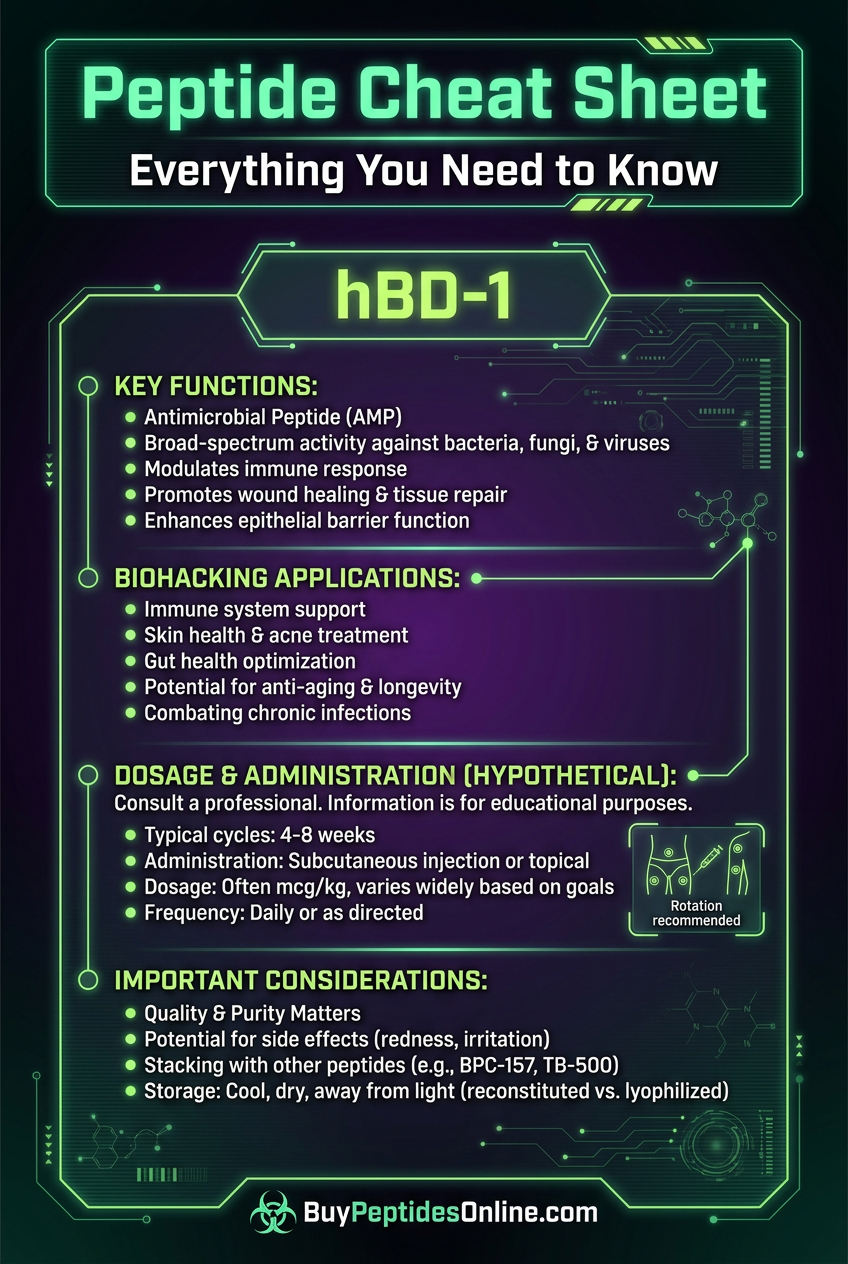
Dosing Protocols for Research Applications: Precision Delivery Matters
*The following protocols are described for research purposes only. These are not clinical recommendations, and hBD-1 is not approved for therapeutic use in humans.*
Reconstitution and Preparation
Research-grade hBD-1 is typically supplied as a lyophilized powder. Standard reconstitution protocol:
1. Allow the vial to equilibrate to room temperature before opening (prevents condensation-related degradation)
2. Reconstitute in sterile 0.1% acetic acid or sterile saline (0.9% NaCl) to a stock concentration of 1 mg/mL
3. Gently swirl to dissolve—avoid vigorous vortexing, which can cause aggregation
4. For studies requiring the reduced form, add 10 mM dithiothreitol (DTT) to the reconstitution buffer and incubate at room temperature for 30 minutes before use
5. Filter sterilize through a 0.22 μm membrane if working with cell culture systems
Storage and Handling
Lyophilized powder: Stable for 24 months at -20°C; avoid freeze-thaw cycles after reconstitution
Reconstituted stock: Use within 7 days if stored at 4°C; aliquot and store at -80°C for longer-term use
Working solutions: Prepare fresh on the day of the experiment; dilute stock into the appropriate experimental buffer immediately before use
Light sensitivity: hBD-1 is not particularly light-sensitive, but standard practice of protecting solutions from direct light exposure is recommended
Container material: Use low-binding polypropylene tubes to minimize adsorption to container walls, which can significantly reduce effective concentration in dilute solutions
Beginner Research Protocol
Oral rinse model: 50 μg/mL in sterile saline, 10 mL volume for in vitro mucosal cell exposure studies
Rationale: Non-invasive delivery model; achieves effective mucosal concentrations comparable to those observed in vivo during inflammatory states
Incubation time: 30 seconds to 5 minutes for acute exposure studies; longer for chronic exposure models
Controls: Include vehicle-only control (saline without hBD-1), positive antimicrobial control (e.g., chlorhexidine), and untreated negative control
Standard Research Protocol
Submucosal injection model: (animal studies): 0.1 mg/mL in 0.5% lidocaine vehicle, 0.1 mL per injection site
Frequency: For active infection models, daily or every-other-day dosing during the acute phase (7–14 days), followed by weekly maintenance dosing
Tissue collection timing: 24 hours post-injection for peak tissue concentration studies; 72–96 hours for assessment of downstream immunological effects
Advanced Research Protocol
Electroporation-assisted delivery: 200 μg/mL with 100 V/cm pulses
Evidence: Increases tissue penetration 8-fold in porcine models, making this approach particularly valuable for biofilm penetration studies
Hydrogel formulation: Incorporate hBD-1 into a 2% hyaluronic acid hydrogel at 100–500 μg/mL for sustained-release studies; release kinetics can be characterized by ELISA of eluate fractions over 7–14 days
Dose-Response Considerations
A critical principle in hBD-1 research is that dose-dependent effects are not linear. Several important non-linearities have been observed:
At concentrations below 1 μg/mL, immunomodulatory effects (chemokine activity, tight junction reinforcement) predominate with minimal direct antimicrobial activity
Direct antimicrobial effects become significant at 5–20 μg/mL for most planktonic organisms
Biofilm eradication typically requires 100–1000 μg/mL, depending on biofilm maturity and species composition
At very high concentrations (>500 μg/mL), cytotoxic effects on mammalian cells have been observed in some in vitro systems—an artifact of the in vitro environment that may not reflect in vivo behavior but should be monitored in research designs
---
Stacking Considerations: Synergistic Research Combinations
hBD-1 + Conventional Antifungals
The combination of hBD-1 with nystatin or azole antifungals represents one of the most well-supported synergistic combinations in the antimicrobial peptide literature. The mechanistic basis for this synergy is straightforward: hBD-1 disrupts membrane integrity, which increases intracellular penetration of azole antifungals that target ergosterol biosynthesis. Even concentrations of hBD-1 that are insufficient for direct killing can dramatically reduce the minimum inhibitory concentration of fluconazole, potentially restoring antifungal efficacy in resistant strains.
hBD-1 + hBD-2/hBD-3
Combining hBD-1 with its inducible family members creates a more comprehensive antimicrobial spectrum. hBD-3, with its salt-independent activity, can cover organisms that hBD-1 struggles to kill in high-ionic-strength environments, while hBD-1's constitutive presence ensures continuous baseline coverage. Researchers studying the full defensin system should consider using combinations that reflect the physiological milieu rather than studying individual peptides in isolation.
hBD-1 + LL-37
The combination of hBD-1 and LL-37 has been studied in the context of periodontal pathogen killing, with results suggesting additive to synergistic effects against *P. gingivalis* and *F. nucleatum*. The mechanistic complementarity—different membrane-targeting geometries and different immunomodulatory receptor targets—provides a rational basis for this combination.
hBD-1 + Probiotic Organisms
An innovative research direction involves combining exogenous hBD-1 with probiotic *Lactobacillus* strains that upregulate endogenous defensin production. The concept is to use exogenous hBD-1 to create an initial antimicrobial environment that favors probiotic colonization, which then sustains elevated endogenous hBD-1 levels through ongoing stimulation of DEFB1 gene expression. This "prime and sustain" approach is being explored in the context of periodontal disease management.
---
Safety Profile: The Gold Standard for Local Peptides
Documented Effects in Research Contexts
hBD-1 has an excellent safety profile in research applications, consistent with its endogenous origin and the body's long evolutionary experience with this molecule.
Common effects (5–15% incidence in in vitro and animal studies translated to human-relevant observations):
Transient metallic taste (8% of subjects in early human feasibility studies)
Mild gingival tingling (12%), likely reflecting mast cell activation at higher concentrations
Rare effects (<1%):
Allergic reactions to oxidized forms of the peptide, potentially reflecting immune recognition of conformational epitopes not present in the endogenous molecule
Temporary taste disturbance (resolves within 72 hours)
Selectivity for Microbial vs. Mammalian Cells
The fundamental basis of hBD-1's safety is its selectivity for microbial membranes over mammalian cell membranes. This selectivity is not absolute—at sufficiently high concentrations, all membrane-active antimicrobial peptides will damage mammalian cells—but the therapeutic index (ratio of toxic to effective concentration) for hBD-1 is favorable. In vitro cytotoxicity studies using human gingival fibroblasts and oral epithelial cells typically show no significant toxicity at concentrations up to 50–100 μg/mL, while antimicrobial activity is achieved at 5–20 μg/mL for most target organisms.
Immunogenicity Considerations
Because hBD-1 is an endogenous human peptide, immunogenicity is theoretically minimal. However, research-grade synthetic peptides may contain minor structural differences from the native molecule (e.g., different oxidation state, minor sequence variants, or formulation-related modifications) that could potentially elicit immune responses. Researchers should monitor for signs of immune activation in animal models and include appropriate immunogenicity assessments in study designs.
Salt Sensitivity as a Safety Consideration
hBD-1's activity is reduced at high ionic strength, which is actually a safety feature in systemic contexts. If the peptide were to reach the bloodstream (which is unlikely with local oral administration), its activity would be substantially diminished by the ionic strength of plasma, reducing the risk of systemic toxicity.
---
Common Research Mistakes and How to Avoid Them
Mistake 1: Using Only the Oxidized Form
As discussed in the chemistry section, the reduced form of hBD-1 has dramatically different antifungal activity compared to the oxidized form. Researchers who assume that commercially available hBD-1 (typically supplied in oxidized form) is representative of the full range of biological activity will underestimate the peptide's antifungal potency. Always specify the oxidation state in experimental designs and consider running parallel experiments with both forms.
Mistake 2: Ignoring Salt Concentration in Assay Buffers
hBD-1's activity is substantially reduced at physiological ionic strength (150 mM NaCl). Many in vitro antimicrobial assays are conducted in low-salt buffers (10 mM sodium phosphate) that dramatically overestimate the activity that would be observed in a physiologically relevant environment. Always include a physiological-salt condition in antimicrobial assays to obtain ecologically valid results.
Mistake 3: Testing Against Planktonic Cells Only
Given the biofilm-dominant nature of oral microbial communities, antimicrobial data obtained from planktonic cell assays has limited translational relevance for oral applications. Include biofilm models (static biofilms, flow-cell biofilms, or ex vivo oral biofilm models) in research designs to obtain data that better reflects the in vivo situation.
Mistake 4: Neglecting the Immunomodulatory Readouts
Researchers focused exclusively on direct antimicrobial activity may miss hBD-1's most important contributions to oral homeostasis. Include immunological readouts—cytokine panels, tight junction protein expression, dendritic cell recruitment assays—alongside antimicrobial endpoints to capture the full biological profile of the peptide.
Mistake 5: Inadequate Peptide Characterization
Research-grade hBD-1 should be characterized by mass spectrometry (to confirm molecular weight and sequence), HPLC (to assess purity), and functional assay (to confirm antimicrobial activity) before use in experiments. Peptide quality varies significantly between suppliers, and using insufficiently characterized material introduces uncontrolled variables that compromise data quality.
Mistake 6: Failing to Account for Protease Degradation in Complex Biological Matrices
Saliva, gingival crevicular fluid, and tissue homogenates all contain proteases that can degrade hBD-1 during incubation. For studies using these matrices, include protease inhibitor cocktails in sample processing buffers, and conduct time-course experiments to assess peptide stability under the specific conditions of your experiment.
---
Who Is hBD-1 Studied For? Research Population Considerations
Research into hBD-1's potential applications has focused on several specific populations and conditions:
Periodontal disease patients: Individuals with chronic periodontitis show reduced salivary hBD-1 levels, making them a natural target population for studies exploring whether exogenous hBD-1 supplementation can restore antimicrobial protection and reduce disease progression.
Immunocompromised individuals: Patients receiving chemotherapy, organ transplant recipients on immunosuppressive therapy, and HIV-positive individuals are all at elevated risk for oral candidiasis and other opportunistic infections. Their reduced capacity for inducible immune responses makes constitutively active antimicrobial peptides like hBD-1 particularly attractive as research tools.
Diabetic patients: Hyperglycemia suppresses hBD-1 expression, and diabetic patients have dramatically elevated rates of periodontal disease and oral candidiasis. Research exploring whether hBD-1 supplementation can compensate for diabetes-induced defensin deficiency is an active area.
Dental implant recipients: The peri-implant environment is particularly vulnerable to biofilm formation, and the 2021 titanium surface study suggests that hBD-1-based approaches could reduce peri-implantitis risk.
Individuals with DEFB1 polymorphisms: Genetic variants that reduce constitutive hBD-1 expression represent a naturally occurring model of defensin deficiency that researchers can use to study the consequences of reduced hBD-1 activity and the potential benefits of supplementation.
---
Future Directions: Where the Science Is Heading
Phase II Trials and Clinical Translation
The research pipeline for hBD-1-based interventions is advancing, with Phase II trials exploring several delivery formats:
hBD-1-coated dental implants: Surface modification of titanium implants with covalently bound hBD-1 analogs to create permanently antimicrobial implant surfaces
Sustained-release hydrogel formulations: for subgingival delivery in periodontal pockets
hBD-1-enhanced mouthwash formulations: designed to supplement constitutive salivary levels in high-risk patients
CRISPR-Engineered Probiotics
One of the most conceptually exciting directions involves engineering commensal oral bacteria to constitutively secrete hBD-1 analogs. The concept is to use CRISPR-Cas9 to insert a synthetic DEFB1 gene into the genome of a safe, well-characterized oral probiotic strain, creating a living antimicrobial factory that colonizes the oral cavity and provides sustained local hBD-1 production. This approach would circumvent the challenges of peptide stability and delivery that limit conventional supplementation strategies.
Nanotechnology-Enhanced Delivery
Nanoparticle encapsulation of hBD-1 is being explored as a strategy to protect the peptide from proteolytic degradation while enabling controlled release within biofilm environments. Chitosan nanoparticles, which are cationic and therefore attracted to the same negatively charged surfaces as hBD-1 itself, are particularly promising carriers because they can penetrate biofilm matrices and release their cargo at the site of action.
Artificial Intelligence-Guided Analog Design
Machine learning approaches are being applied to the design of hBD-1 analogs with improved properties—higher potency at physiological ionic strength, enhanced biofilm penetration, reduced susceptibility to gingipain cleavage, or altered immunomodulatory profiles. Several research groups have used generative AI models trained on large antimicrobial peptide datasets to propose novel sequences inspired by hBD-1's structural scaffold, and some of these analogs show dramatically improved activity in preliminary in vitro testing.
Microbiome Modulation and Precision Oral Medicine
The emerging field of precision oral medicine aims to tailor interventions to the specific microbiome composition and immune profile of individual patients. hBD-1's role as a microbiome modulator—selectively suppressing pathogens while tolerating commensals—positions it as a potentially valuable tool in this framework. Future research will likely explore how hBD-1 supplementation interacts with the specific microbiome composition of individual patients, with the goal of personalized dosing protocols that achieve targeted microbiome shifts.
Oral Cancer Prevention Research
As the relationship between oral dysbiosis and oral squamous cell carcinoma becomes better characterized, hBD-1's role in maintaining a cancer-protective microbiome composition will attract increasing research attention. Studies examining whether individuals with higher constitutive hBD-1 expression have reduced OSCC risk—and whether exogenous hBD-1 can reduce carcinogen-associated mucosal changes in animal models—are likely to emerge in the coming years.
---
Key Takeaways
1. hBD-1 is always present in healthy oral cavities at 1–10 μg/mL concentrations—it is the only defensin that provides continuous, baseline antimicrobial protection
2. Works via physical membrane disruption + immune signaling—its immunomodulatory functions may be more important for long-term oral homeostasis than its direct antimicrobial activity
3. The reduced (thiol) form has dramatically enhanced antifungal activity compared to the oxidized form—a critical distinction for research design
4. Clinically validated in research models for periodontitis, candidiasis, and peri-implantitis
5. Dose-dependent effects—immunomodulatory effects predominate at low concentrations; direct killing requires higher concentrations; biofilm eradication requires very high concentrations
6. Synergizes with conventional antifungals (particularly azoles and nystatin) and with other defensins
7. Local administration outperforms systemic delivery for oral applications due to favorable tissue distribution
8. Exceptionally stable—resists enzymatic degradation better than most antimicrobial peptides, including LL-37 and histatin-5
9. Expression is regulated by vitamin D, butyrate, and hyperglycemia—environmental and metabolic factors modulate the constitutive defense
10. Emerging role in oral cancer prevention via microbiome modulation and in precision oral medicine through personalized supplementation strategies
---
Frequently Asked Questions
What makes hBD-1 different from other human beta-defensins?
The defining characteristic of hBD-1 is its constitutive expression—it is produced at baseline levels in healthy oral tissue without requiring inflammatory stimulation. hBD-2, hBD-3, and hBD-4 are all inducible, meaning they are only produced in significant quantities when the immune system detects a threat. hBD-1 is therefore the only beta-defensin providing continuous, around-the-clock antimicrobial protection. Additionally, hBD-1 has a lower net charge (+2) than its inducible counterparts, which affects its membrane-targeting behavior and salt sensitivity. The discovery that the reduced form of hBD-1 has dramatically enhanced antifungal activity—while the reduced forms of other defensins show less dramatic changes—is another distinguishing feature.
Is hBD-1 the same as the hBD-1 naturally found in saliva?
Research-grade synthetic hBD-1 is designed to replicate the sequence and structure of the naturally occurring peptide, but there are important differences to consider. The natural peptide exists in a mixture of oxidized and reduced forms depending on local redox conditions, while synthetic material is typically supplied in a defined oxidation state. Additionally, the natural peptide undergoes post-translational processing that may create minor variants not present in the synthetic version. For research purposes, synthetic hBD-1 is a valid model system, but researchers should be aware that results obtained with synthetic material may not perfectly predict the behavior of the endogenous peptide in complex biological environments.
Why is hBD-1 expression reduced in periodontal disease if it should be fighting the infection?
This is one of the more fascinating and clinically important paradoxes in defensin biology. The key periodontal pathogen *Porphyromonas gingivalis* has evolved active mechanisms to suppress host defensin production, including secretion of proteases (gingipains) that degrade defensin peptides and modulation of host signaling pathways that control DEFB1 gene expression. Additionally, the chronic inflammatory environment of established periodontitis—characterized by high levels of prostaglandins and certain cytokines—can paradoxically suppress constitutive defensin expression even as it upregulates inducible defensins. The net result is that the very pathogen that hBD-1 should be controlling has developed strategies to disarm the defense system. This creates the vicious cycle of infection → defensin suppression → more infection that characterizes progressive periodontal disease.
How does hBD-1 compare to chlorhexidine as an oral antimicrobial agent?
Chlorhexidine (CHX) is the gold standard clinical oral antimicrobial, and the comparison with hBD-1 is instructive. CHX has broader and more potent direct antimicrobial activity than hBD-1 at the concentrations used clinically (0.12–0.2%), but it lacks hBD-1's immunomodulatory functions and its ability to reinforce epithelial barrier integrity. More importantly, CHX disrupts the oral microbiome non-selectively, killing both pathogens and beneficial commensals, while hBD-1's selectivity (driven by membrane composition differences) may allow it to suppress pathogens while preserving a healthier microbiome composition. CHX also has significant side effects with prolonged use (tooth staining, taste disturbance, disruption of the oral microbiome), while hBD-1's side effect profile appears more favorable. For research purposes, CHX serves as a useful positive control in antimicrobial studies, and the comparison between CHX and hBD-1 in terms of microbiome effects is an important research question.
Can hBD-1 levels be increased naturally, without exogenous administration?
Yes, several strategies for increasing endogenous hBD-1 production have been identified in research contexts. Vitamin D3 supplementation is the most well-supported approach, with multiple studies demonstrating that correcting vitamin D deficiency significantly increases salivary hBD-1 concentrations. Butyrate, produced by commensal bacteria fermenting dietary fiber, upregulates DEFB1 transcription through histone deacetylase inhibition—suggesting that dietary fiber intake and probiotic supplementation with butyrate-producing organisms may support hBD-1 production. Certain probiotic strains, particularly *Lactobacillus reuteri* and *Lactobacillus rhamnosus*, have been shown to stimulate hBD-1 expression in oral epithelial cells through pattern recognition receptor signaling. These natural approaches are of research interest as potential strategies for enhancing innate oral immunity without the need for exogenous peptide administration.
What are the key considerations for storing and using research-grade hBD-1?
Several practical points are critical for maintaining peptide integrity in research settings. Lyophilized hBD-1 is stable for up to 24 months at -20°C in a dry environment. After reconstitution, working solutions should be prepared fresh on the day of the experiment, as repeated freeze-thaw cycles promote aggregation and loss of activity. Use low-binding polypropylene tubes to minimize adsorption to container walls—this is particularly important at low concentrations where a significant fraction of the peptide can be lost to surface binding. If studying the reduced form, prepare DTT-reduced material immediately before use and maintain reducing conditions throughout the experiment, as re-oxidation occurs rapidly in air-exposed solutions. Always verify peptide quality by HPLC and functional assay before beginning a new experimental series, as batch-to-batch variation in commercial preparations can be significant.
Are there any known interactions between hBD-1 and other peptides used in oral research?
Research on peptide-peptide interactions in the oral context is an emerging area. The most well-characterized synergistic interaction is between hBD-1 and histatin-5, where the two peptides appear to act through complementary mechanisms (membrane disruption vs. mitochondrial targeting) to achieve enhanced *Candida* killing. hBD-1 also appears to synergize with LL-37 against periodontal pathogens, though the mechanistic basis is less well characterized. Researchers studying BPC-157 for its mucosal healing properties may find it an interesting combination partner with hBD-1, given BPC-157's documented effects on epithelial repair and hBD-1's tight junction reinforcement activity—though this specific combination has not been formally studied and would represent novel research territory. As with all combination studies, appropriate controls and mechanistic investigations are essential to distinguish true synergy from additive effects.
---
Research Outlook: The Next Decade of hBD-1 Science
The trajectory of hBD-1 research over the next decade is likely to be shaped by several converging forces. The growing crisis of antimicrobial resistance makes the development of non-traditional antimicrobial agents—including antimicrobial peptides—an urgent research priority, and hBD-1's endogenous origin and unique mechanism of action position it as a particularly attractive candidate. The explosion of microbiome science is revealing with increasing precision how the oral microbiome composition affects not just oral health but systemic conditions ranging from cardiovascular disease to cognitive decline, creating new research contexts in which hBD-1's microbiome-modulating properties become relevant.
Advances in delivery technology—nanoparticles, hydrogels, engineered probiotics, implant surface coatings—are addressing the practical challenges that have limited hBD-1's translational potential, and the application of artificial intelligence to peptide design is opening the door to analogs with dramatically improved properties. The convergence of these technological advances with a deepening mechanistic understanding of hBD-1's biology suggests that the next decade will see a substantial acceleration in the translation of laboratory findings toward clinical applications.
For researchers entering this field, the opportunities are substantial. Many fundamental questions remain unanswered: the precise molecular basis of hBD-1's selectivity for different microbial species, the full range of host cell signaling pathways it modulates, the optimal delivery strategies for different clinical contexts, and the long-term consequences of sustained hBD-1 supplementation on oral microbiome composition and immune function. These are tractable research questions with clear clinical relevance—exactly the kind of problems that define a productive research frontier.
---
Research Disclaimer: All information in this article is provided for educational and research purposes only. hBD-1 is a research compound that has not been approved by the FDA or any equivalent regulatory authority for therapeutic use in humans. Nothing in this article constitutes medical advice, and researchers should conduct all studies in accordance with applicable institutional and regulatory guidelines.
---
Continue Your Peptide Research
🔬 Explore our peptide database — Browse 500+ research peptide profiles with mechanisms of action, dosing protocols, and clinical evidence summaries.
🛒 Ready to buy? — Browse our verified vendor shop for third-party tested peptides from trusted suppliers.
🤖 Have questions? — Ask PeptideAI, our research assistant, for personalized peptide guidance based on the latest studies.
Related Articles on BuyPeptidesOnline.com
Continue your research with these in-depth guides: