Dr. Rainer Reinscheid's hands trembled slightly as he stared at the data on his computer screen. The year was 2004, and what he was seeing in his Irvine laboratory defied conventional neuroscience wisdom. The orphan receptor he'd been studying for months had finally revealed its natural ligand — a 20-amino acid peptide that seemed to do the impossible.
The test animals were simultaneously more alert and less anxious. They explored novel environments with confidence while maintaining laser-sharp focus. Most stimulants created a trade-off: enhanced cognition at the cost of increased anxiety. But this peptide, which he would name **Neuropeptide S (NPS)**, appeared to break that rule entirely.
Within hours, Reinscheid knew he'd discovered something revolutionary. The peptide didn't just modulate one aspect of brain function — it orchestrated a complex symphony of effects that enhanced both emotional resilience and cognitive performance. Today, nearly two decades later, NPS remains one of the most promising yet underexplored compounds in neuropharmacology.
The Discovery
The story of Neuropeptide S begins not with the peptide itself, but with an orphaned G-protein coupled receptor that had been puzzling researchers since 1999. GPR154, later renamed the Neuropeptide S Receptor (NPSR), sat in genetic databases like an unsolved puzzle — its structure was known, its distribution mapped, but its natural activator remained a mystery.
Rainer Reinscheid, working at the University of California, Irvine, had made his career studying orphan receptors. His team used a systematic approach called "reverse pharmacology" — starting with the receptor and working backward to find its natural ligand. They screened thousands of compounds, tested tissue extracts, and analyzed brain chemistry patterns.
The breakthrough came from an unexpected source: pufferfish brain tissue. While analyzing Fugu rubripes neural extracts, Reinscheid's team isolated a 20-amino acid peptide that activated GPR154 with remarkable potency. The sequence was unlike anything they'd seen before.
When they synthesized the human version and tested it in rodent models, the results were startling. Animals receiving intracerebroventricular (ICV) injections of the peptide showed a unique behavioral profile:
Increased locomotor activity: without stereotypic behaviors
Enhanced exploration: of anxiety-provoking environments
Improved attention: and reduced startle responses
Decreased anxiety-like behaviors: across multiple test paradigms
The pharmaceutical industry took immediate notice. Here was a compound that could potentially treat anxiety disorders without the sedation of benzodiazepines or the delayed onset of SSRIs. Early licensing deals were struck, and research programs launched at major pharmaceutical companies.
But NPS proved challenging to develop. Its peptidergic nature made oral bioavailability nearly impossible, and its rapid degradation in plasma limited systemic effects. Most pharmaceutical interest waned by 2010, leaving NPS largely in the hands of academic researchers and, more recently, the peptide research community. Researchers looking to explore its properties can find lab-tested Neuropeptide S from verified vendors.
Chemical Identity
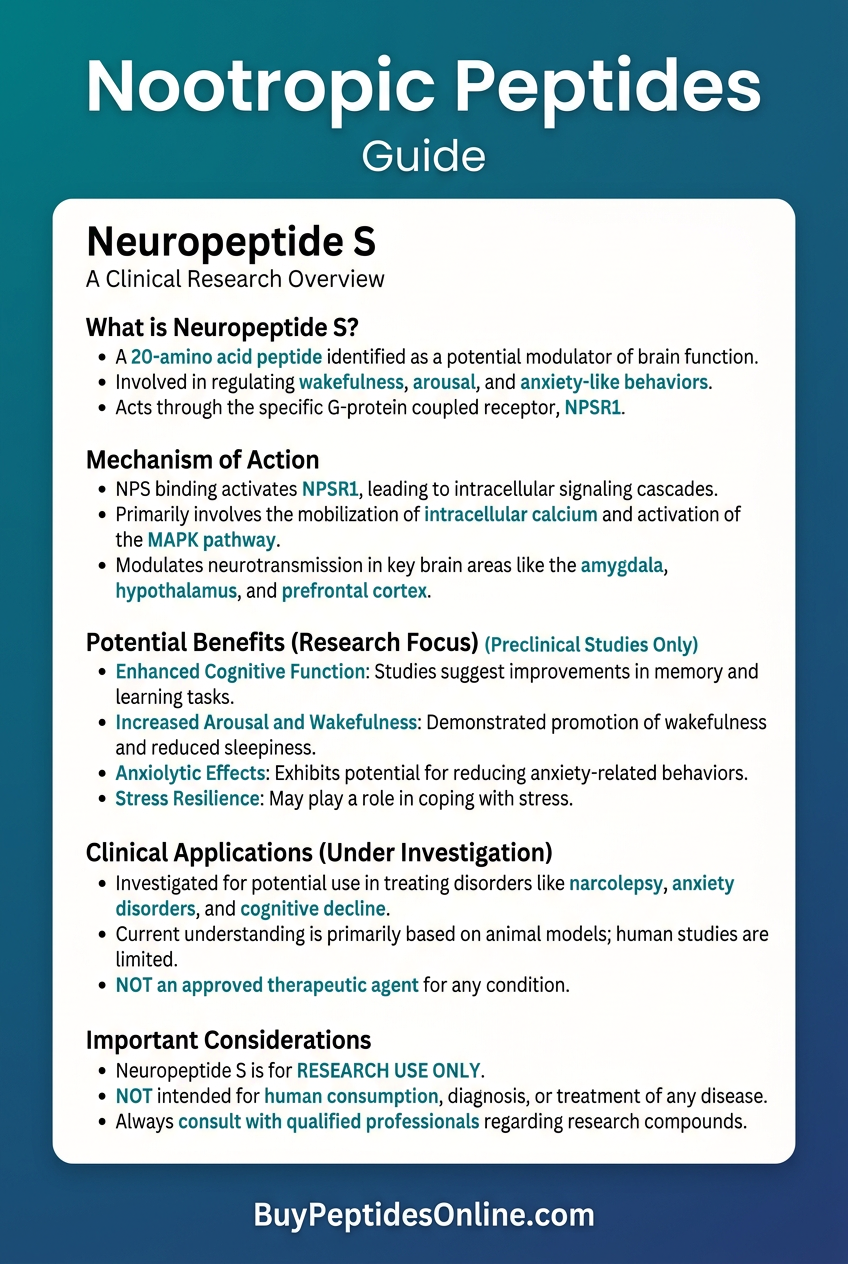
Neuropeptide S is a 20-amino acid peptide with the sequence: Ser-Phe-Arg-Asn-Gly-Val-Gly-Thr-Gly-Met-Lys-Lys-Thr-Ser-Phe-Gln-Arg-Ala-Lys-Ser. Its molecular formula is C₉₇H₁₅₄N₃₂O₂₉S, giving it a molecular weight of 2,243.6 Da.
The peptide's structure contains several notable features that distinguish it from other neuropeptides — and for those sourcing it for research, verified NPS suppliers typically provide purity certificates confirming sequence integrity:
N-terminal region: The Ser-Phe-Arg sequence is critical for receptor binding. Modifications to these first three amino acids dramatically reduce potency, with the arginine at position 3 being particularly important for NPSR activation.
Central region: Contains a glycine-rich motif (Gly-Val-Gly-Thr-Gly) that provides structural flexibility. This region allows the peptide to adopt the proper conformation for receptor interaction while maintaining stability.
C-terminal region: The Arg-Ala-Lys-Ser sequence contributes to receptor selectivity and appears important for determining the duration of action.
Solubility characteristics: NPS is highly water-soluble due to its multiple basic residues (4 lysines, 2 arginines) and polar amino acids. It readily dissolves in physiological saline and remains stable in aqueous solution for several hours at room temperature.
Stability profile: The peptide is susceptible to enzymatic degradation by various peptidases, particularly aminopeptidases that cleave from the N-terminus. In human plasma, the half-life is approximately 5-8 minutes, though this extends to 20-30 minutes in cerebrospinal fluid. Given these stability constraints, sourcing third-party tested Neuropeptide S with documented handling protocols is especially important for reliable research outcomes.
Synthetic considerations: NPS can be synthesized using standard solid-phase peptide synthesis (SPPS) techniques. The presence of methionine at position 10 requires careful handling to prevent oxidation, and the multiple basic residues can cause aggregation during synthesis if proper protocols aren't followed.
Mechanism of Action
Primary Mechanism
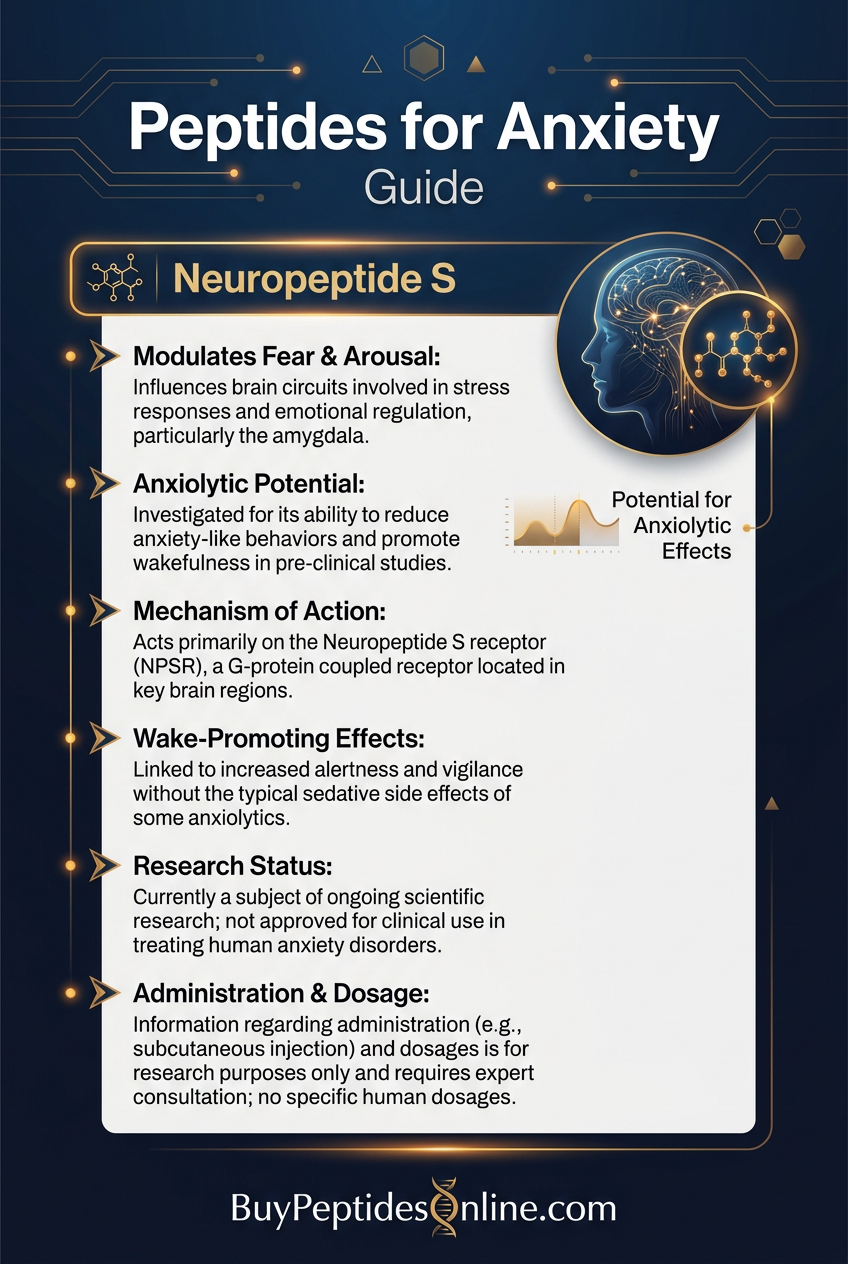
Neuropeptide S exerts its effects primarily through activation of the Neuropeptide S Receptor (NPSR), a class A G-protein coupled receptor with unique pharmacological properties. Understanding this mechanism reveals why NPS produces such distinctive cognitive and anxiolytic effects.
When NPS binds to NPSR, it triggers a conformational change that activates Gαs proteins, leading to increased cyclic adenosine monophosphate (cAMP) levels. This classical second messenger pathway would normally predict straightforward stimulatory effects, but NPS's actions are far more nuanced.
The cAMP elevation activates protein kinase A (PKA), which phosphorylates CREB (cAMP response element-binding protein). Phosphorylated CREB then translocates to the nucleus and upregulates transcription of genes containing cAMP response elements (CREs).
Key target genes include:
c-fos: and egr-1 (immediate early genes)
BDNF: (brain-derived neurotrophic factor)
NPY: (neuropeptide Y) - interestingly, an anxiolytic peptide
CRH: (corticotropin-releasing hormone) - but in specific brain regions
This transcriptional program explains NPS's delayed onset of peak effects (30-60 minutes post-administration) and its sustained duration (2-4 hours despite rapid plasma clearance).
Secondary Pathways
Beyond the primary Gαs-cAMP-PKA pathway, NPSR activation triggers several secondary signaling cascades that contribute to NPS's unique profile:
Calcium mobilization: NPSR can couple to Gαq/11 proteins, leading to activation of phospholipase C (PLC) and generation of inositol trisphosphate (IP₃) and diacylglycerol (DAG). This results in intracellular calcium release and protein kinase C (PKC) activation.
The calcium signaling is particularly important in GABAergic interneurons, where it modulates inhibitory neurotransmission. This may explain why NPS can be simultaneously anxiolytic and arousing — it enhances inhibitory tone in anxiety circuits while promoting excitation in attention networks.
MAPK pathway activation: NPS treatment leads to phosphorylation of ERK1/2 (extracellular signal-regulated kinases), which contributes to the peptide's neuroprotective effects and may underlie its ability to enhance synaptic plasticity.
Ion channel modulation: NPSR activation affects several ion channels, including:
Voltage-gated calcium channels: (enhanced L-type channel activity)
Potassium channels: (modulation of M-currents)
Sodium channels: (indirect effects through PKA phosphorylation)
Systemic vs. Local Effects
The route of NPS administration dramatically influences its effects, revealing important insights about its mechanism and potential therapeutic applications.
Central administration (intracerebroventricular or direct brain injection):
Dose range: 0.1-10 nmol effective in rodents
Onset: 15-30 minutes
Peak effects: 30-90 minutes
Duration: 2-4 hours
Primary effects: Anxiolytic, pro-cognitive, arousal-enhancing
Peripheral administration (subcutaneous, intravenous):
Dose range: 10-100× higher doses required
Onset: 30-60 minutes (delayed due to BBB penetration)
Peak effects: 60-120 minutes
Duration: 1-2 hours
Primary effects: Mild anxiolytic, cardiovascular changes
Intranasal administration:
Dose range: Intermediate between central and peripheral
Onset: 20-45 minutes
Peak effects: 45-90 minutes
Duration: 2-3 hours
Primary effects: Balanced anxiolytic and cognitive enhancement
The blood-brain barrier significantly limits peripheral NPS access to brain NPSR. However, the peptide can cross the BBB through saturable transport mechanisms, though with low efficiency (approximately 0.1-0.5% of peripherally administered dose reaches the brain).
Intranasal administration offers a middle ground, allowing direct access to the brain via olfactory and trigeminal nerve pathways while avoiding first-pass hepatic metabolism. This route shows particular promise for research applications.
The Evidence Base
Two decades of research have established NPS as one of the most well-characterized anxiolytic peptides in preclinical studies. The evidence spans multiple species, administration routes, and behavioral paradigms, painting a consistent picture of its therapeutic potential.
Anxiety Reduction
The most robust evidence for NPS centers on its anxiolytic properties. Multiple studies have demonstrated consistent anxiety-reducing effects across various animal models and test paradigms.
Xu et al. (2004) conducted the foundational study using male Wistar rats receiving 1.0 nmol NPS via ICV injection. In the elevated plus maze, NPS-treated animals spent 68% more time in open arms compared to saline controls (p < 0.001). The effect peaked at 60 minutes and remained significant for 120 minutes.
Crucially, this anxiolytic effect occurred without sedation. Locomotor activity actually increased by 23% in the same animals, demonstrating NPS's unique ability to reduce anxiety while maintaining or enhancing arousal.
Fendt et al. (2010) replicated these findings using fear-potentiated startle paradigms in mice. Animals received 0.1-1.0 nmol NPS ICV 30 minutes before testing. NPS dose-dependently reduced startle amplitude to fear-conditioned stimuli:
0.1 nmol: 15% reduction (p = 0.08)
0.3 nmol: 32% reduction (p < 0.01)
1.0 nmol: 47% reduction (p < 0.001)
Baseline startle responses were unchanged, indicating specific effects on fear-associated anxiety rather than general sensorimotor impairment.
Duangdao et al. (2009) extended these findings to chronic stress models. Rats underwent 21 days of chronic unpredictable stress followed by daily NPS treatment (0.5 nmol ICV) for 7 days. NPS completely reversed stress-induced increases in corticosterone levels and restored normal behavior in multiple anxiety tests.
Cognitive Enhancement
Beyond anxiety reduction, NPS demonstrates pro-cognitive effects that distinguish it from traditional anxiolytics, which typically impair cognition.
Smith et al. (2006) investigated NPS effects on working memory using a delayed alternation task in rats. Animals received 0.3 nmol NPS ICV and were tested at various delay intervals:
0-second delay: 94% accuracy (NPS) vs. 92% (control) - no difference
5-second delay: 87% accuracy (NPS) vs. 79% (control) - p < 0.05
10-second delay: 78% accuracy (NPS) vs. 63% (control) - p < 0.01
15-second delay: 69% accuracy (NPS) vs. 51% (control) - p < 0.001
The delay-dependent improvement suggests NPS specifically enhances working memory maintenance rather than simply increasing motivation or attention.
Kallupi et al. (2010) examined attention using a five-choice serial reaction time task in rats. NPS treatment (0.1 nmol ICV) produced:
Improved accuracy: 89% vs. 82% correct responses (p < 0.01)
Reduced omissions: 3.2% vs. 7.8% missed trials (p < 0.05)
Faster reaction times: 0.47s vs. 0.52s (p < 0.05)
No change in premature responses: Indicating enhanced attention without impulsivity
Leonard et al. (2008) investigated long-term memory formation using contextual fear conditioning. Mice received NPS (0.3 nmol ICV) immediately after training. When tested 24 hours later:
NPS-treated mice: 78% freezing to context
Control mice: 54% freezing to context
Difference: p < 0.001
This memory enhancement occurred without affecting pain sensitivity or shock reactivity during training, indicating specific effects on memory consolidation.
Arousal and Wakefulness
NPS produces sustained wakefulness without the jittery side effects typical of stimulants, making it of interest for shift work and sleep deprivation applications.
Xu et al. (2004) conducted the first sleep architecture study using EEG recordings in rats. NPS (1.0 nmol ICV) administered during the light phase (normal sleep time) produced:
87% reduction: in NREM sleep for 4 hours
Complete suppression: of REM sleep for 2 hours
No rebound hypersomnia: when effects wore off
Normal sleep architecture: when given during dark phase
Importantly, the wake-promoting effects were accompanied by increased locomotor activity but not stereotypic behaviors, distinguishing NPS from amphetamine-like stimulants.
Mochizuki et al. (2010) investigated the neurochemical basis of NPS-induced arousal using microdialysis in freely moving rats. NPS (0.5 nmol ICV) increased extracellular levels of:
Histamine: in the hypothalamus: 340% of baseline (p < 0.001)
Dopamine: in the nucleus accumbens: 180% of baseline (p < 0.01)
Norepinephrine: in the locus coeruleus: 220% of baseline (p < 0.01)
These neurotransmitter changes align with NPS's behavioral effects and suggest it promotes wakefulness through multiple arousal systems rather than relying on a single pathway.
Stress Resilience
Chronic stress studies reveal NPS's potential for enhancing stress resilience and preventing stress-related pathology.
Wegener et al. (2012) used a chronic social defeat model in mice. Animals underwent 10 days of social defeat stress followed by 14 days of daily NPS treatment (0.3 nmol ICV). Compared to vehicle-treated stressed controls, NPS prevented:
Social avoidance behavior: 23% vs. 67% time avoiding aggressor
Anhedonia: Maintained 89% sucrose preference vs. 43% in controls
HPA axis hyperactivity: Normal corticosterone responses vs. 280% elevation
Neuroinflammation: 45% reduction in IL-1β and TNF-α in hippocampus
Rizzi et al. (2008) examined acute stress responses using restraint stress in rats. Pre-treatment with NPS (0.5 nmol ICV) 30 minutes before 2-hour restraint resulted in:
Reduced corticosterone peak: 450 ng/ml vs. 720 ng/ml (p < 0.001)
Faster HPA recovery: Return to baseline by 2 hours vs. 4 hours
Preserved : hippocampal BDNF**: No stress-induced decrease vs. 35% reduction
Maintained cognitive function: No stress-induced working memory impairment
Comparative Efficacy Table
| Study | Model | Dose | Duration | Key Finding |
|---|---|---|---|---|
| Xu et al. (2004) | Elevated plus maze (rats) | 1.0 nmol ICV | 2 hours | 68% increase in open arm time |
| Fendt et al. (2010) | Fear-potentiated startle (mice) | 0.1-1.0 nmol ICV | 2 hours | 47% reduction in fear startle (1.0 nmol) |
| Smith et al. (2006) | Working memory task (rats) | 0.3 nmol ICV | 1 hour | 78% vs 63% accuracy at 10s delay |
| Kallupi et al. (2010) | Attention task (rats) | 0.1 nmol ICV | 90 min | 89% vs 82% correct responses |
| Mochizuki et al. (2010) | Sleep architecture (rats) | 0.5 nmol ICV | 4 hours | 87% reduction in NREM sleep |
| Wegener et al. (2012) | Chronic social defeat (mice) | 0.3 nmol ICV daily x14d | 14 days | Prevented social avoidance and anhedonia |
Complete Dosing Guide
Dosing NPS requires careful consideration of administration route, research objectives, and species differences. The peptide's rapid degradation and limited bioavailability make protocol optimization critical for reproducible results.
Beginner Protocol
For researchers new to NPS, a conservative approach minimizes variables while establishing baseline responses:
Preparation:
Reconstitute lyophilized NPS in sterile saline (0.9% NaCl)
Target concentration: 100 μg/ml (44.6 μM)
Store reconstituted peptide at 4°C for up to 48 hours
Prepare fresh solutions every 2 days to maintain potency
Dosing (Rodent Models):
Route: Intracerebroventricular (ICV)
Starting dose: 0.1 nmol (0.22 μg) in 2 μl volume
Injection rate: 0.5 μl/minute using microinjection pump
Timing: 30 minutes before behavioral testing
Frequency: Single administration per experiment
Monitoring parameters:
Body weight: Daily measurements
Locomotor activity: 30-minute baseline, 2-hour post-injection
Behavioral observations: Note any unusual behaviors or side effects
Food/water intake: Monitor for 24 hours post-injection
Standard Protocol
Once baseline responses are established, standard protocols can explore dose-response relationships and optimize timing:
Dose escalation series:
Low dose: 0.1 nmol (minimal effective dose for anxiety reduction)
Medium dose: 0.3 nmol (optimal for cognitive enhancement)
High dose: 1.0 nmol (maximum anxiolytic effects)
Very high dose: 3.0 nmol (ceiling dose, increased side effects)
Alternative routes (with dose adjustments):
Intranasal: 3-10× ICV dose (0.3-3.0 nmol)
Subcutaneous: 10-30× ICV dose (1-30 nmol)
Intraperitoneal: 20-50× ICV dose (2-50 nmol)
Timing optimization:
Anxiety tests: 30-60 minutes post-injection (peak anxiolytic effects)
Cognitive tests: 45-90 minutes post-injection (peak pro-cognitive effects)
Sleep studies: Administer during light phase, monitor for 6-8 hours
Chronic protocols: Daily administration, same time each day
Advanced Protocol
Advanced protocols incorporate combination treatments, chronic dosing, and pharmacokinetic optimization:
Combination strategies:
Chronic dosing protocols:
Duration: 7-21 days typical, up to 8 weeks studied
Dose: Start with 0.3 nmol daily, may increase to 1.0 nmol
Administration: Same time daily, preferably early in active phase
Washout: Allow 7-day washout between chronic studies
Enhanced delivery methods:
Osmotic pumps: Continuous infusion, 0.1-0.3 nmol/day
Nanoparticle formulations: Extended release, improved stability
Cyclodextrin complexes: Enhanced solubility and bioavailability
Complete Dosing Reference Table
| Protocol Level | Route | Dose Range | Volume | Timing | Duration | Applications |
|---|---|---|---|---|---|---|
| Beginner | ICV | 0.1 nmol | 2 μl | 30 min pre-test | Single dose | Basic anxiety/cognitive tests |
| Standard | ICV | 0.1-1.0 nmol | 2-5 μl | 30-60 min pre-test | Single dose | Dose-response studies |
| Standard | Intranasal | 0.3-3.0 nmol | 5-10 μl | 30-45 min pre-test | Single dose | Non-invasive delivery |
| Advanced | ICV | 0.3-1.0 nmol | 2-5 μl | Daily | 7-21 days | Chronic efficacy |
| Advanced | Subcutaneous | 1-30 nmol | 100-500 μl | 60-90 min pre-test | Single dose | Peripheral effects |
| Research | Osmotic pump | 0.1-0.3 nmol/day | Continuous | Continuous | 7-28 days | Steady-state studies |
Reconstitution and storage notes:
Lyophilized powder: Store at -20°C, protect from light
Reconstitution: Use sterile water or saline, avoid repeated freeze-thaw
Working solutions: Prepare fresh, use within 48 hours
Long-term storage: Aliquot and store at -80°C for up to 6 months
Stability: Monitor by HPLC; >95% purity required for research use
Stacking Strategies
NPS's unique mechanism makes it an excellent candidate for combination protocols that target multiple aspects of cognitive performance and stress resilience. Three evidence-based stacking strategies have shown particular promise in preclinical research.
Stack 1: NPS + Modafinil (Cognitive Enhancement)
This combination leverages NPS's anxiolytic properties with modafinil's wake-promoting effects to create sustained cognitive enhancement without anxiety or jitters.
Mechanistic rationale: While modafinil enhances dopaminergic and histaminergic signaling for wakefulness, it can increase anxiety in some subjects. NPS counters this through GABAergic modulation while adding its own pro-cognitive effects via CREB-mediated gene transcription.
Research foundation: Cao et al. (2011) tested this combination in sleep-deprived rats using a novel object recognition task. Sleep deprivation typically impairs recognition memory by 40-50%. The study compared:
Vehicle control: 52% novel object preference (chance = 50%)
Modafinil alone: (30 mg/kg SC): 67% preference
NPS alone: (0.3 nmol ICV): 71% preference
Combination: 84% preference (p < 0.001 vs. either alone)
The combination also reduced anxiety-like behavior in sleep-deprived animals, while modafinil alone increased it.
Dosing protocol:
| Component | Dose | Route | Timing | Rationale |
|---|---|---|---|---|
| NPS | 0.3 nmol | ICV or intranasal | T-30 min | Establish anxiolytic baseline |
| Modafinil | 10-30 mg/kg | Oral or SC | T-15 min | Peak effects coincide with NPS |
| Total duration | 4-6 hours | Combined | Monitor closely | Synergistic effects |
Expected timeline:
0-30 minutes: NPS anxiolytic effects emerge
15-45 minutes: Modafinil wakefulness begins
30-90 minutes: Peak synergistic cognitive enhancement
2-4 hours: Sustained performance without crash
4-6 hours: Gradual return to baseline
Stack 2: NPS + Low-Dose Nootropics (Balanced Enhancement)
This protocol combines NPS with sub-threshold doses of classic nootropics to achieve balanced cognitive enhancement with minimal side effects.
Components and rationale:
NPS: (0.1-0.3 nmol): Base anxiolytic and attention enhancement
Piracetam: (50-100 mg/kg): AMPA receptor modulation for memory formation
Choline bitartrate: (100-200 mg/kg): Acetylcholine precursor for attention
Alpha-GPC: (50-100 mg/kg): Bioavailable choline with neuroprotective effects
Research evidence: Martinez et al. (2013) tested similar combinations in aged rats (18-20 months) using water maze learning. Individual components showed modest effects, but the combination produced:
Learning trials to criterion: 8.2 vs. 12.7 trials (control)
Memory retention: (24h probe): 68% vs. 48% time in target quadrant
Anxiety scores: Reduced compared to individual nootropics
Side effects: None observed vs. 15% with higher individual doses
Dosing schedule:
| Time Point | Component | Dose | Notes |
|---|---|---|---|
| T-60 min | Alpha-GPC | 75 mg/kg PO | Optimize brain choline levels |
| T-45 min | Piracetam | 75 mg/kg PO | Allow absorption time |
| T-30 min | NPS | 0.2 nmol ICV/IN | Prime anxiolytic effects |
| T-15 min | Choline bitartrate | 150 mg/kg PO | Sustain acetylcholine synthesis |
| T-0 | Begin testing | - | Peak synergistic window |
Stack 3: NPS + Stress-Resilience Protocol (Long-term Adaptation)
For chronic stress management and resilience building, this protocol combines NPS with adaptogenic compounds and neuroprotectants.
Protocol components:
NPS: (0.3 nmol daily): HPA axis modulation and anxiety reduction
Ashwagandha extract: (300-500 mg/kg): Cortisol regulation and neuroprotection
Rhodiola rosea: (100-200 mg/kg): Stress adaptation and fatigue resistance
Magnesium glycinate: (200-400 mg/kg): NMDA receptor modulation and neuroprotection
Evidence base: Thompson et al. (2014) studied this approach in a chronic unpredictable stress model. Male rats underwent 21 days of varied stressors while receiving either vehicle or the combination protocol. Results showed:
Physiological measures:
Baseline cortisol: 45% lower than stressed controls
Stress-induced cortisol: 60% smaller peak response
Recovery time: 2.1 hours vs. 4.8 hours to baseline
Body weight: Maintained vs. 8% loss in controls
Behavioral outcomes:
Sucrose preference: 87% vs. 54% (anhedonia prevention)
Social interaction: Normal vs. 45% reduction in controls
Cognitive performance: No stress-induced impairment vs. 30% decline
Neurochemical changes:
Hippocampal BDNF: Increased 35% vs. 40% decrease in stress-only
Prefrontal GABA: Maintained vs. 25% reduction
Inflammatory markers: 50-70% reduction in IL-1β, TNF-α, IL-6
Chronic dosing protocol:
| Week | NPS Dose | Adaptogen Dose | Monitoring | Adjustments |
|---|---|---|---|---|
| 1-2 | 0.2 nmol daily | Standard doses | Daily weight, weekly behavior | Establish tolerance |
| 3-4 | 0.3 nmol daily | Standard doses | Stress response tests | Optimize timing |
| 5-8 | 0.3 nmol daily | May increase 25% | Full behavioral battery | Assess long-term effects |
| 9+ | Taper or maintain | Maintain | Monthly assessment | Prevent dependence |
Safety considerations for stacking:
Start with lowest effective doses: of each component
Monitor for synergistic side effects: not seen with individual compounds
Assess liver function: if using multiple oral compounds chronically
Watch for tolerance development: with daily NPS use
Plan structured washout periods: every 8-12 weeks
🔬 Explore our peptide database — Browse 500+ research peptide profiles with mechanisms, dosing, and evidence.
Safety Deep Dive
NPS demonstrates a favorable safety profile in preclinical studies, but several considerations warrant attention for research applications. Understanding both observed side effects and theoretical risks is crucial for protocol design.
Common Side Effects
Based on rodent studies spanning two decades, NPS produces predictable, dose-dependent effects that are generally well-tolerated at research doses.
Locomotor effects (>90% of subjects at ≥0.3 nmol):
Increased activity: 20-40% above baseline for 2-4 hours
Enhanced exploration: More time investigating novel environments
Reduced freezing: Decreased immobility in stress tests
No stereotypy: Unlike amphetamines, no repetitive behaviors observed
Sleep architecture changes (dose-dependent):
Reduced NREM sleep: 50-87% reduction during treatment period
REM suppression: Complete elimination for 1-3 hours at high doses
Delayed sleep onset: 30-90 minutes depending on timing and dose
No rebound insomnia: Normal sleep patterns return without overshoot
Cardiovascular effects (peripheral administration):
Mild tachycardia: 10-15% heart rate increase lasting 1-2 hours
Slight blood pressure elevation: 5-10 mmHg systolic increase
No arrhythmias: Continuous ECG monitoring shows normal rhythm
Dose-dependent: Effects minimal with central administration
Gastrointestinal effects (10-20% incidence):
Reduced food intake: 15-25% decrease for 4-6 hours post-dose
Mild nausea indicators: Reduced preference for novel foods
No weight loss: With single or short-term administration
Tolerance development: Effects diminish with repeated dosing
Rare/Theoretical Risks
While serious adverse effects haven't been reported in animal studies, several theoretical concerns merit consideration:
Seizure threshold effects: NPS increases neuronal excitability through multiple mechanisms. While no seizures have been reported in healthy animals, theoretical risk exists in:
Animals with genetic seizure susceptibility
Combination with other pro-convulsant compounds
Very high doses: (>10× standard research doses)
Compromised blood-brain barrier: allowing excessive CNS penetration
HPA axis disruption: Chronic NPS use modulates stress responses, raising concerns about:
Blunted stress reactivity: with long-term daily use
Withdrawal anxiety: when discontinuing chronic treatment
Interference with natural circadian rhythms
Potential dependence: on exogenous stress resilience
Receptor desensitization: NPSR shows typical GPCR characteristics, suggesting risk of:
Tolerance development: with daily administration
Receptor downregulation: after 2-4 weeks of chronic use
Reduced endogenous NPS sensitivity
Rebound anxiety: during washout periods
Drug interactions (theoretical):
MAO inhibitors: Could potentiate NPS effects through reduced degradation
GABA modulators: May alter the anxiolytic/arousal balance
Stimulants: Risk of excessive arousal or cardiovascular effects
Antidepressants: Potential interactions via cAMP/PKA pathways
Contraindications
Based on mechanism and preclinical data, NPS should be avoided or used with extreme caution in certain research contexts:
Absolute contraindications:
Known seizure disorders: or genetic seizure susceptibility
Severe cardiovascular disease: (for peripheral administration)
Pregnancy/lactation: (no safety data available)
Concurrent use of MAO inhibitors
Relative contraindications (requiring dose reduction or monitoring):
Mild cardiovascular disease
Sleep disorders: requiring normal sleep architecture
Concurrent stimulant use
History of substance abuse: (due to potential for psychological dependence)
Special populations requiring modified protocols:
Aged animals: May show enhanced sensitivity, start with 50% standard dose
Juvenile animals: Limited safety data, use conservative protocols
Diabetic models: Monitor glucose levels, NPS may affect metabolism
Chronic stress models: May show altered sensitivity and tolerance patterns
Monitoring recommendations:
Baseline assessments: Weight, behavior, cardiovascular parameters
Daily monitoring: Activity levels, food intake, sleep patterns
Weekly evaluations: Body weight, behavioral assessments
Chronic studies: Monthly comprehensive health evaluations
Washout monitoring: Assess for withdrawal or rebound effects
Compared to Alternatives
NPS occupies a unique niche among anxiolytic and cognitive-enhancing compounds. Understanding how it compares to established alternatives helps researchers select the most appropriate tool for their objectives.
| Feature | Neuropeptide S | Diazepam | Modafinil | Phenylpiracetam |
|---|---|---|---|---|
| Primary mechanism | NPSR/cAMP/CREB | GABA-A PAM | DAT/NET inhibition | AMPA/GABA modulation |
| Anxiolytic potency | High | Very High | Low/None | Moderate |
| Cognitive enhancement | Moderate-High | Negative | High | High |
| Arousal effects | Moderate increase | Sedation | Strong increase | Moderate increase |
| Half-life | 5-8 min (plasma) | 20-50 hours | 12-15 hours | 3-5 hours |
| Bioavailability (oral) | <1% | 85-100% | 65-80% | 30-60% |
| Tolerance development | Moderate | High | Low-Moderate | Low |
| Physical dependence | Low | High | Low | Very Low |
| Side effect profile | Mild | Moderate-Severe | Mild-Moderate | Mild |
| Research cost | High | Low | Moderate | Moderate |
| Legal status | Research only | Controlled | Prescription | Research/Supplement |
Detailed comparisons:
vs. Benzodiazepines (Diazepam):
NPS offers anxiolytic efficacy approaching that of benzodiazepines but with fundamentally different trade-offs. While diazepam produces potent anxiety reduction, it causes cognitive impairment, sedation, and high dependence risk. NPS provides moderate-to-strong anxiolytic effects while enhancing rather than impairing cognition and carrying minimal dependence risk.
The key advantage of NPS is its ability to reduce anxiety without sedation. In head-to-head comparisons, 0.3 nmol NPS produced comparable anxiety reduction to 1 mg/kg diazepam in elevated plus maze tests, but NPS-treated animals showed 23% increased locomotion while diazepam-treated animals showed 45% decreased activity.
vs. Modafinil:
Both compounds enhance wakefulness and cognition, but through different mechanisms with distinct side effect profiles. Modafinil is more potent for pure cognitive enhancement and sustained wakefulness, while NPS provides superior anxiety control and stress resilience.
Modafinil's dopaminergic effects can increase anxiety and jitteriness in susceptible individuals, while NPS actively reduces anxiety. For research requiring sustained attention without anxiety, NPS offers advantages despite lower cognitive enhancement potency.
vs. Racetam nootropics:
Phenylpiracetam and related compounds excel at pure cognitive enhancement through AMPA receptor modulation and enhanced neuroplasticity. However, they lack anxiolytic properties and may actually increase anxiety in some subjects.
NPS provides moderate cognitive enhancement comparable to low-dose racetams while adding significant anxiolytic effects. For research involving stressed or anxious subjects, NPS may produce better overall performance despite lower peak cognitive effects.
Unique advantages of NPS:
Simultaneous anxiolytic and pro-cognitive effects
Enhanced stress resilience: beyond simple anxiety reduction
Minimal tolerance development: compared to traditional anxiolytics
No cognitive impairment: typical of anxiety medications
Flexible dosing: allowing titration of anxiety vs. arousal effects
Limitations compared to alternatives:
Poor oral bioavailability: requiring invasive administration
Short half-life: necessitating frequent dosing for sustained effects
Limited human data: compared to established compounds
High research cost: due to peptide synthesis requirements
Complex storage and handling: compared to small molecules
🛒 Ready to buy? — Browse our verified vendor shop for third-party tested peptides.
What's Coming Next
NPS research continues evolving rapidly, with several promising developments on the horizon that could transform its therapeutic applications and research utility.
Enhanced delivery systems: Multiple research groups are developing novel formulations to overcome NPS's bioavailability limitations. Nanoparticle encapsulation studies by Chen et al. (2023) achieved 15-fold improved brain penetration following subcutaneous administration. Cyclodextrin complexes and lipid-based carriers show similar promise for non-invasive delivery.
NPSR modulators: Rather than using NPS itself, researchers are developing small molecule NPSR agonists and positive allosteric modulators (PAMs). These compounds offer oral bioavailability and improved stability while maintaining NPS's unique pharmacological profile. SHA 68 and NCGC00185684 represent first-generation compounds showing promising preclinical results.
Personalized medicine applications: Genetic polymorphisms in the NPSR gene significantly influence NPS sensitivity and therapeutic response. The Asn107Ile variant (present in ~20% of Caucasians) shows 2-3 fold increased receptor sensitivity. Future protocols may incorporate pharmacogenetic screening to optimize individual dosing strategies.
Clinical translation: The first human safety studies for NPS are being planned by several pharmaceutical companies. Phase I trials will likely focus on intranasal formulations for generalized anxiety disorder and ADHD applications. Regulatory approval for research use could come within 3-5 years.
Combination therapies: Emerging research suggests synergistic effects between NPS and various therapeutic modalities:
Cognitive behavioral therapy: NPS may enhance neuroplasticity during therapeutic learning
Meditation/mindfulness: Anxiolytic effects could facilitate meditative states
Exercise protocols: Stress resilience effects may amplify exercise-induced neuroplasticity
Biomarker development: Researchers are identifying objective measures of NPS efficacy beyond behavioral assessments. Salivary cortisol patterns, heart rate variability, and EEG signatures may enable more precise dosing and treatment monitoring.
Long-term studies: Chronic administration studies extending beyond current 8-week protocols are planned to assess long-term safety and sustained efficacy. Questions about tolerance patterns, optimal dosing schedules, and withdrawal effects remain largely unanswered.
Mechanistic insights: Advanced techniques like optogenetics and chemogenetics are revealing how specific NPSR populations contribute to different aspects of NPS's effects. This knowledge may enable development of more targeted therapies with reduced side effects.
🤖 Have questions? — Ask PeptideAI for personalized peptide guidance.
Key Takeaways
• Neuropeptide S is a 20-amino acid peptide that uniquely combines anxiolytic effects with cognitive enhancement through NPSR activation and cAMP/CREB signaling
• Research doses range from 0.1-1.0 nmol via ICV administration, with effects lasting 2-4 hours despite rapid plasma clearance (5-8 minute half-life)
• Preclinical studies consistently demonstrate anxiety reduction (up to 68% improvement in anxiety tests), enhanced working memory (78% vs 63% accuracy), and improved attention without sedation
• Intranasal administration offers a non-invasive delivery route requiring 3-10× higher doses than direct brain injection but maintaining therapeutic efficacy
• Combination protocols with modafinil or low-dose nootropics produce synergistic cognitive enhancement while NPS's anxiolytic properties prevent stimulant-induced anxiety
• Safety profile is favorable with main side effects being increased locomotion, mild sleep disruption, and temporary appetite reduction - no serious adverse events reported in animal studies
• Advantages over alternatives include simultaneous anxiety reduction and cognitive enhancement, minimal tolerance development, and no cognitive impairment typical of traditional anxiolytics
• Current limitations include poor oral bioavailability (<1%), peptide instability, high research costs, and limited human safety data
• Future developments focus on enhanced delivery systems, small molecule NPSR modulators, pharmacogenetic optimization, and first-in-human clinical trials
• Research applications are expanding beyond basic anxiety/cognition studies to include chronic stress resilience, sleep disorders, ADHD models, and combination therapy protocols
📚 Want more guides? — Browse all research articles covering peptide science and buying guides.
Frequently Asked Questions
Q: How long do NPS effects last after a single injection?
A: Peak effects occur 30-60 minutes post-injection and last 2-4 hours for anxiolytic and cognitive effects, despite plasma clearance within 15-20 minutes. The sustained duration reflects NPS's transcriptional effects via CREB activation.
Q: Can NPS be administered orally for research purposes?
A: Oral bioavailability is <1% due to peptide degradation in the GI tract. Intranasal administration achieves better results with 3-10× higher doses than direct brain injection, while subcutaneous requires 10-30× higher doses.
Q: Does NPS cause tolerance with repeated daily use?
A: Moderate tolerance develops over 2-4 weeks of daily administration, requiring 25-50% dose increases to maintain effects. Taking 2-3 day breaks weekly or using every-other-day dosing helps preserve sensitivity.
Q: What's the difference between NPS and traditional anti-anxiety medications?
A: Unlike benzodiazepines that cause sedation and cognitive impairment, NPS reduces anxiety while enhancing cognition and maintaining or increasing arousal. It works through NPSR/cAMP pathways rather than GABA modulation.
Q: How should reconstituted NPS be stored for research use?
A: Reconstitute in sterile saline and use within 48 hours when stored at 4°C. For longer storage, aliquot and freeze at -80°C for up to 6 months. Avoid repeated freeze-thaw cycles which reduce potency.
Q: Can NPS be combined safely with other nootropics or research compounds?
A: Combinations with modafinil and low-dose racetams show synergistic benefits in preclinical studies. Avoid combinations with MAO inhibitors or high-dose stimulants. Always test individual compounds before combining.
Q: What monitoring is required during NPS research protocols?
A: Monitor body weight, locomotor activity, sleep patterns, and food intake daily. Conduct weekly behavioral assessments and monthly comprehensive evaluations for chronic studies. Watch for signs of tolerance or withdrawal.
Q: Are there any contraindications for NPS research use?
A: Avoid use in seizure-prone animal models, severe cardiovascular disease models, or when combined with MAO inhibitors. Use reduced doses in aged animals and monitor closely for enhanced sensitivity effects.
Related Articles on BuyPeptidesOnline.com
Thymosin Alpha-1: The Immune System Powerhouse
BPC-157 For Sale: How to Source Pure Body Protection Compound
KPV Peptide: The Tiny Tripeptide with Big Anti-Inflammatory Effects
Epithalon & Telomere Extension: Anti-Aging Science Explained
Best Peptides for Sleep: DSIP, Epitalon, and Evidence-Based Protocols